




Google Analytics 4 (GA4) is not just a platform upgrade. It represents a fundamental shift in how marketing performance should be understood, measured, and evaluated.
Many teams initially approached GA4 as a replacement for Universal Analytics, but that framing misses the real point. GA4 forces marketers to rethink what performance actually means in a privacy-first, multi-device, non-linear customer journey.
The biggest change is not the interface or the reports. The real change is the measurement philosophy.
From sessions to users and events
Universal Analytics was built around sessions and pageviews. GA4 is built around users and events.
This change matters because modern customer journeys do not behave like sessions. A single user may interact across devices, platforms, and timeframes before converting.
Google’s own documentation confirms that GA4’s event-based model was designed to better reflect real user behaviour across apps and websites.
Instead of treating interactions as isolated visits, GA4 treats them as part of an ongoing relationship.
This shift pushes marketers away from surface-level traffic metrics and toward behavioural depth. Metrics such as:
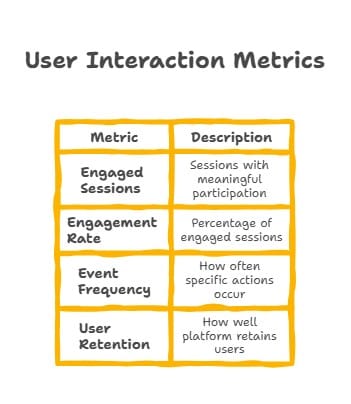
are designed to answer a more important question: What did users actually do, and did it matter?
Why traditional performance metrics break under GA4
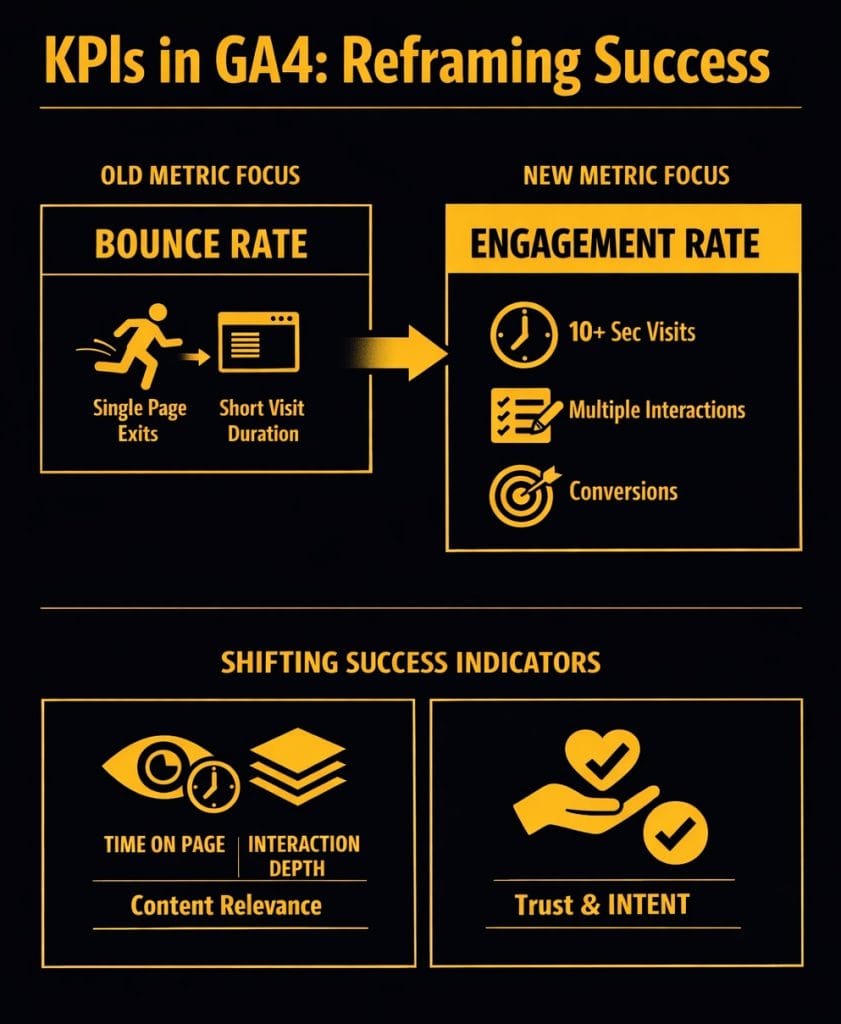
Many familiar KPIs lose their meaning inside GA4.
Bounce rate, for example, is no longer the primary indicator of content performance.
Instead, GA4 emphasises engagement rate, defined as sessions that last longer than 10 seconds, include multiple events, or result in a conversion.
Time-on-page and interaction depth are stronger indicators of content relevance than single-page exits.
A user can consume valuable information and leave without navigating further, yet still gain trust and intent.
GA4 corrects this misinterpretation by reframing what “success” looks like at the interaction level.
Upgrade your analytics strategy with our GA4 optimization services
Performance measurement in a privacy-first world
Another major reason GA4 changes performance measurement is privacy regulation. With increasing restrictions from GDPR, CCPA, and browser-level tracking limitations, GA4 was built to operate with less reliance on cookies.
Google has confirmed that GA4 uses modelling and aggregated data to fill gaps when user-level data is unavailable. This means marketers must become more comfortable with directional accuracy rather than perfect attribution.
According to Optimise Smart, consented user data combined with behavioural modelling allows GA4 to maintain trend reliability even when full data capture is not possible. This pushes teams to evaluate performance through patterns and outcomes, not absolute numbers.
The implication is critical: performance measurement must shift from “exact attribution” to incremental impact and outcome-based analysis.
GA4 reframes conversions as strategic decisions
In Universal Analytics, goals were often created casually. In GA4, every conversion must be deliberately defined. Any event can be marked as a conversion, which forces teams to decide what truly represents value.
This has a strategic consequence. When everything can be a conversion, nothing should be by default.
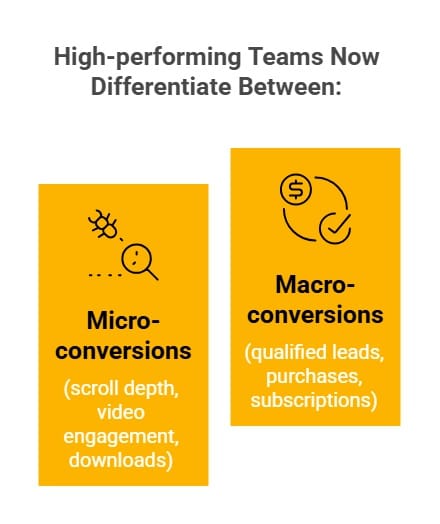
According to Boston Consultant Group, organisations that align measurement around value-based conversions rather than volume metrics improve marketing efficiency by 20–30% over time. GA4 structurally supports this approach by separating event tracking from conversion designation.
New metrics that matter more than old benchmarks
GA4 introduces metrics that better align with business outcomes:
Measurement Focus | Old Approach | GA4-Oriented Approach |
Traffic quality | Sessions | Engaged users |
Content success | Pageviews | Engagement time |
Funnel health | Drop-offs | Event paths |
Growth | New users | Retention cohorts |
ROI analysis | Last-click | Data-driven attribution |
Engagement time, in particular, replaces average session duration as a more stable indicator.
Google explains that engagement time measures active interaction, excluding idle or background time, making it more reflective of true attention.
Read this also: How AI Is Transforming Digital Marketing
Ready to adapt to GA4? Let’s build a smarter measurement strategy for your business.
Attribution becomes less about credit, more about insight
GA4 defaults to data-driven attribution, moving away from rigid last-click or first-click models. This is a significant philosophical shift.
Data-driven attribution uses machine learning to assign value across touchpoints based on observed conversion paths.
Google reports that advertisers using data-driven attribution see improved alignment between spend and outcomes, particularly in complex, multi-channel journeys.
However, this also means marketers must stop asking “Which channel gets credit?” and start asking “Which combination of actions drives outcomes?”
GA4 is not designed to settle internal debates. It is designed to inform better decisions.
A practical example of GA4-driven measurement change
A B2B company migrating to GA4 noticed that traffic volume appeared flat compared to Universal Analytics. Initially, this raised concerns. However, GA4 revealed that:
- Engaged users increased by 18%
- Engagement time per user increased
- Event completion rates improved
- Sales-qualified leads rose despite lower reported sessions
Focusing on engagement and qualified events rather than raw traffic, the company identified which content and channels were driving real intent.
The reporting looked quieter, but the business results improved.
This is a recurring pattern with GA4: less noise, more signal.
The strategic takeaway
GA4 does not reward surface-level optimisation. It rewards clarity, intent, and alignment with business value.
Teams that continue to chase vanity metrics inside GA4 often feel lost.
Teams that redesign their measurement frameworks around behaviour, value, and outcomes gain sharper insight and better performance control.
GA4 is not telling marketers to measure less. It is telling them to measure smarter.
Read this also: 10 Best Social Media Marketing Strategies for Beauty Brands
Conclusion
GA4 fundamentally changes marketing performance measurement by shifting the focus from volume to value, from sessions to behaviour, and from attribution to outcomes.
It forces organisations to rethink what success actually means in a privacy-first, multi-touch environment.
Brands that want to fully leverage GA4’s measurement philosophy often partner with specialists like Kings Digital.
We help translate GA4 data into meaningful, decision-ready performance frameworks rather than surface-level reports.
Frequently Asked Questions
How is GA4 fundamentally different from Universal Analytics?
GA4 uses an event-based measurement model instead of a session-based one. This allows marketers to track user behaviour across devices and platforms more accurately. Rather than focusing on visits and pageviews, GA4 measures meaningful interactions, engagement, and long-term user behaviour.
Why does GA4 place so much emphasis on engagement metrics?
GA4 prioritises engagement because traditional metrics like bounce rate often misrepresented user intent. Engagement metrics, such as engaged sessions and engagement time, provide a clearer picture of whether users found content relevant and valuable, even if they did not navigate through multiple pages.
How does GA4 handle performance measurement in a privacy-first environment?
GA4 relies less on cookies and uses consented data combined with behavioural modelling. This approach allows marketers to maintain reliable performance trends even when full user-level data is unavailable. As a result, GA4 encourages analysis based on patterns and outcomes rather than perfect attribution.
What should be considered a conversion in GA4?
In GA4, any event can be marked as a conversion, which makes conversion definition a strategic decision.
High-value actions such as qualified leads, purchases, or subscriptions should be prioritised, while engagement actions should be treated as supporting indicators rather than primary success metrics.
Does GA4 make attribution more accurate or more complex?
GA4 makes attribution more adaptive by using data-driven attribution models that distribute credit across multiple touchpoints.
While this reduces reliance on last-click attribution, it also requires marketers to focus less on channel credit and more on understanding which user behaviours and journeys lead to meaningful outcomes.