
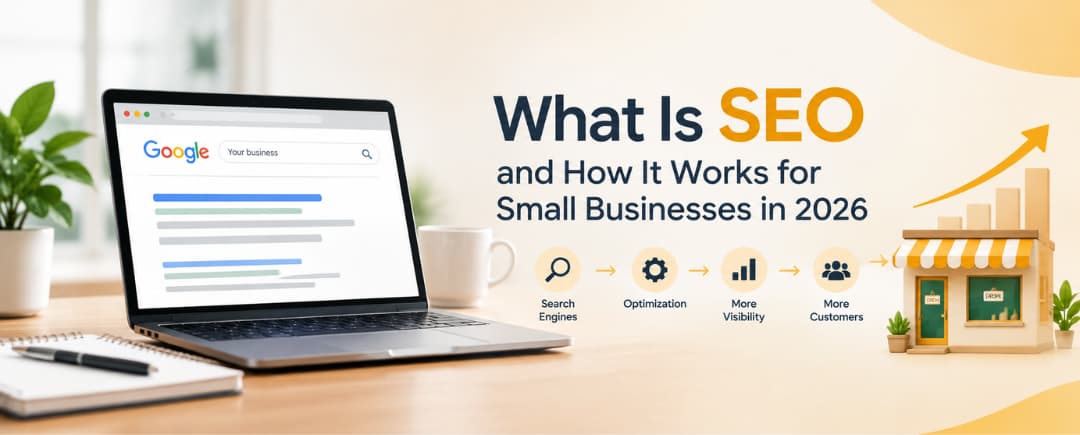


Running a small business in 2026 is not only about having a good product or service. People also need to be able to find you online, across Google, Maps, and AI-powered search.
That is where SEO comes in.
SEO, or Search Engine Optimization, is the process of improving your website so that search engines like Google can understand it and show it to people searching for products, services, or information related to your business.
Google itself explains SEO as helping search engines understand your content while also helping users discover your website and decide whether they should visit it.
For a small business, good SEO can mean more website visitors, phone calls, store visits, enquiries, bookings, and sales without paying for every click.
And in 2026, SEO goes beyond traditional Google rankings. Businesses also need to think about Google AI Overviews, AI Mode, ChatGPT, voice search, maps, and other AI-powered search experiences.
The Basics
What Is SEO?
SEO is the process of making your website easier to find when someone searches online.
Imagine that you own a dental clinic in Calgary. Someone searches:
"dentist near me"
"best dentist in Calgary"
"emergency dentist Calgary"
"teeth whitening near me"
SEO helps Google understand that your clinic provides these services and serves people in Calgary.
If Google sees your website as useful, relevant, trustworthy, and easy to understand, it may show your business higher in the search results.
The same idea applies to restaurants, salons, gyms, home service companies, consultants, online stores, healthcare businesses, and almost every other small business.
Why It Matters Now
Why SEO Is More Important in 2026
Search is changing quickly.
People still use Google, but they are also asking longer questions and using AI tools to find businesses.
Google reported in May 2026 that AI Overviews had more than 2.5 billion monthly active users, while AI Mode had already passed 1 billion monthly active users.
This means a business should no longer think only about ranking as a blue link on Google. Your information should also be clear enough for AI systems to understand, summarize, and recommend.
Local search is especially important for small businesses. BrightLocal's 2026 consumer research backs this up, and the growth in AI-assisted local discovery has been sharp — up from just 6% the year before.
That is a strong reason why SEO for small business should be part of a long-term marketing plan.
The Process
How Does SEO Work for a Small Business?
SEO usually works in several steps.
Search engines first need to discover your website. Google uses automated programs called crawlers to find pages across the web.
After finding a page, Google tries to understand what the page is about. It then decides whether that page may be useful for a particular search.
Your SEO work helps make this process easier.
Keyword research identifies what your customers are searching for. For example, a plumbing company may target searches such as:
- Emergency plumber
- Plumber near me
- Water heater repair
- Bathroom plumbing services
- Local plumbing company
Good keyword research does not simply find popular words. It focuses on searches that match what the business actually offers, and it considers search intent. Someone searching "what causes a leaking tap?" may be looking for information. Someone searching "emergency plumber near me" is probably much closer to hiring a plumber. Both searches can be useful, but they need different content.
On-page SEO improves the content and structure of individual website pages. It includes areas such as page titles, headings, keywords, meta descriptions, internal links, images, service descriptions, FAQs, and helpful written content.
For example, if you provide accounting services for small companies, your page should clearly explain what services you offer, who you help, where you operate, and why a customer may choose you. The goal is not to repeat a keyword again and again — the goal is to answer the searcher's question clearly.
Even excellent content can struggle if the website has technical problems. Technical SEO helps search engines find, crawl, understand, and index a website correctly. Common work includes:
- Improving website speed
- Making pages mobile-friendly
- Fixing broken links and crawl errors
- Improving URL structure
- Creating XML sitemaps
- Adding structured data or schema
- Improving website security
- Improving Core Web Vitals
Google recommends websites that are secure, fast, accessible, and usable across different devices. Technical SEO creates the foundation that supports all other SEO work.
Content is one of the main ways a small business can answer the questions customers are already asking. A roofing company, for example, could publish content about roof repair signs, costs, replacement time, materials, and maintenance tips.
Useful content can bring people to the website before they are ready to buy. Later, when they need the service, they may already know the business. In 2026, content should also be written so AI search systems can understand it easily — using clear questions and answers, simple definitions, descriptive headings, short paragraphs, reliable statistics, examples, comparison tables, FAQs, and first-hand expertise where possible.
Google says website content should focus on accuracy, quality, relevance, and value for users, including when AI tools are used during content creation.
For businesses that serve a particular city or area, local SEO can be extremely important. It helps a company appear when people search for nearby products and services, such as "coffee shop near me" or "electrician in Delhi."
A strong local SEO strategy can include:
- Creating and optimizing a Google Business Profile
- Choosing correct business categories
- Adding services, products, and photos
- Keeping business hours and NAP details consistent
- Managing customer reviews
- Creating city or location pages
- Building local citations and relevant backlinks
- Adding local business schema
71% of local searches start with Google Search or Maps — and reviews matter just as much as ranking.
See Local SEO ServicesBrightLocal found in 2026 that only 6% of consumers simply clicked the top local result. People also looked closely at location, star ratings, number of reviews, complete business information, and pricing. So ranking is important, but trust is just as important.
Search engines also look at signals that can help them understand whether a website is trustworthy and useful. One important signal is backlinks — when another website links to your website. A local newspaper may mention your business and link to your site, or an industry website may reference one of your guides.
Good backlinks can support your website's authority. However, quality matters much more than simply collecting thousands of random links. Businesses should focus on relevant and trustworthy websites rather than buying low-quality links.
SEO in 2026 also includes visibility inside AI-generated answers. People may ask "What is the best physiotherapy clinic near me?" or "Which accounting company is good for small businesses?" AI systems may gather information from websites and other online sources before presenting an answer.
This makes clear business information, useful content, strong brand signals, structured data, reviews, expert information, and trusted mentions increasingly valuable. Google has also introduced Search Console reporting designed to help website owners understand their visibility within generative AI experiences such as AI Overviews and AI Mode.
The Shift
How the Customer Journey Has Changed
For small businesses, this means modern SEO should work for both traditional search results and AI search experiences.
Services Overview
What Do SEO Services for Small Businesses Usually Include?
Good SEO services for small business should cover more than keywords.
| SEO Service | What It Helps With |
|---|---|
| SEO Audit | Finds problems and opportunities |
| Keyword Research | Finds searches potential customers use |
| On-Page SEO | Improves website pages and content |
| Technical SEO | Improves crawling, speed, indexing, and structure |
| Local SEO | Improves local and map visibility |
| Google Business Profile Optimization | Helps customers find local business information |
| Content Marketing | Attracts people through useful content |
| Link Building | Builds website authority |
| Schema Markup | Helps search engines understand page information |
| AI Search Optimization | Improves content clarity for AI-powered discovery |
| Analytics and Tracking | Measures traffic, leads, rankings, and conversions |
| Conversion Optimization | Helps turn visitors into leads or customers |
A complete SEO strategy may combine several of these services depending on the size of the website and business goals.
The Payoff
Why SEO Is Important for Business
So, why is SEO important for business in the first place? The simple answer is visibility.
If your potential customers are searching for what you sell but your business does not appear, your competitors have a better chance of getting those customers.
SEO can help a small business:
- Reach people already looking for its services
- Increase organic website traffic
- Generate enquiries and leads
- Build local visibility and brand awareness
- Build trust and support long-term marketing
- Reduce complete dependence on paid advertising
- Reach customers at different stages of their buying journey
- Improve visibility in both search engines and AI search
Unlike an advertisement that usually stops when you stop paying, strong SEO pages can continue bringing visitors over time.
That does not mean SEO is free. It takes time, content, technical work, research, and regular improvements. However, it can become a valuable long-term source of customer acquisition.
Comparison
SEO vs Paid Advertising for Small Businesses
SEO and paid advertising serve different purposes.
| SEO | Paid Advertising |
|---|---|
| Focuses on organic visibility | Focuses on paid placements |
| Usually takes time to grow | Can create visibility quickly |
| Can provide long-term traffic | Traffic usually stops when spending stops |
| Builds website authority | Buys immediate exposure |
| Useful for long-term growth | Useful for quick campaigns and offers |
| Does not charge for each organic click | Usually charges per click or impression |
Many businesses use both. Paid ads can create immediate traffic while SEO builds stronger organic visibility over time.
Getting Started
Are Affordable SEO Services for Small Business Worth It?
Yes, affordable SEO services for small business can be valuable when they focus on the right priorities. Affordable should not mean cheap shortcuts.
A smaller company may not need a huge national SEO campaign. It may need:
- A technically healthy website
- Strong service pages
- Google Business Profile optimization
- Local keyword research
- Helpful content
- Review management
- Local links and citations
- Clear conversion tracking
The right SEO plan should match the size, location, competition, and goals of the business.
Be careful with companies that promise guaranteed #1 rankings. Google clearly states that there are no secret methods that automatically place a website first in its search results.
Timeframes
How Long Does SEO Take for a Small Business?
SEO usually does not provide instant results. Google explains that some website changes may show an effect within hours, while others can take several months. It recommends waiting at least a few weeks before judging whether certain SEO improvements have worked.
The actual timeline depends on website condition, competition, location, industry, website authority, content quality, technical issues, backlinks, and how regularly SEO improvements are made.
A newer business in a competitive market may need more time than an established company in a smaller local market. SEO should therefore be treated as steady business growth rather than a quick trick.
SEO in 2026 is no longer only about putting keywords into a webpage and trying to reach the first position on Google. It is about making your business easy to find, understand, trust, and choose across traditional search, local search, Maps, voice search, and AI-powered platforms.
For a small company, the right SEO plan may include technical optimization, strong service pages, useful content, Google Business Profile management, local SEO, structured data, authority building, AI search optimization, and regular performance tracking.
Businesses that want professional support can work with Kings Digital for SEO strategies built around technical SEO, local visibility, content, analytics, and long-term organic growth, helping potential customers discover the business at the moments that matter most.
Let's build an SEO plan sized right for your business and your market.
Frequently Asked Questions
SEO for a small business means improving its website and online presence so potential customers can find it through Google, Maps, AI-powered search, and other search platforms. It can include keywords, content, technical SEO, local SEO, links, reviews, and Google Business Profile optimization.
Yes, especially when customers search online before choosing a product or service. SEO gives a small company the opportunity to appear when people are actively looking for what it offers.
Small business owners can handle basic tasks such as updating a Google Business Profile, writing useful content, checking business details, and learning basic keyword research. More technical or competitive SEO may require professional support.
Yes. Traditional SEO focuses more broadly on website visibility, while local SEO focuses on searches connected to a location. It commonly includes Google Maps, Google Business Profile, reviews, local keywords, location pages, and business citations.
Yes. AI has changed how search results are presented, but the web remains an important source of information for AI-powered search. Clear, trustworthy, well-structured content can support visibility in traditional results as well as AI-generated answers.
No. No legitimate SEO company can guarantee a permanent first position. Search rankings depend on many changing factors, including competition, relevance, website quality, authority, location, and Google's ranking systems.