




The Indian jewellery market has historically been a low-frequency category. Purchases were rare, emotionally heavy, and tied to milestones such as weddings, festivals, or long-term financial planning.
Industry estimates suggest that 60–65% of jewellery sales in India are still occasion-led, and the average household buys jewellery only once every few years.
Against this backdrop, Palmonas achieved a structural shift. It turned jewellery into a repeat-driven, high-frequency lifestyle category.
This transformation was not driven by discounts or distribution alone, but by a deep understanding of consumer behaviour and a carefully sequenced growth strategy.
The Core Problem: Jewellery’s Frequency Gap
Low purchase frequency was the biggest growth constraint in jewellery. While fashion categories such as apparel or footwear see repeat cycles every few months, jewellery remained locked into long intervals. Key behavioural barriers included:
- Jewellery viewed as an asset, not an accessory
- High price anxiety leading to delayed decisions
- Purchases influenced by family approval rather than personal choice
- Limited everyday relevance
Studies show that over 70% of Indian women own jewellery they rarely wear, often storing it for safety or special occasions. Palmonas identified that growth would not come from pushing more products, but from changing how jewellery fits into daily life.
The Consumer Shift Palmonas Built On
Urban Indian women today are financially independent, fashion-conscious, and expressive.
Research indicates that women influence over 80% of lifestyle purchase decisions, and nearly 50% of jewellery purchases in urban India are now self-purchased, not family-driven.
Palmonas aligned itself with this shift by repositioning jewellery as a tool for personal expression, not social obligation.
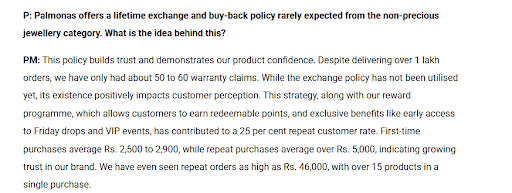
Palmonas optimizes for lifetime value, not one-time conversion. Also, they say that they have a lifetime exchange and buy-back policy and this is very rare and the first approach in the market in this category.
Usually, you can find this in Gold and Silver…
Jewellery as Everyday Fashion: The First Breakthrough
Palmonas reframed jewellery from something “kept safe” to something worn often.
This repositioning enabled three outcomes:
- Jewellery entered daily routines like workwear and casual styling
- The gap between purchases reduced significantly
- Repeat buying became natural, not forced
Once jewellery became part of everyday dressing, it started behaving like fashion, a category where repeat customers drive 65–70% of revenue.
Category Creation Instead of Competition
Rather than competing directly with traditional fine jewellery or imitation accessories, Palmonas introduced demi-fine jewellery.
How This Changed Market Dynamics:
Traditional Fine Jewellery | Fashion Jewellery | Demi-Fine Jewellery (Palmonas) |
High price, low frequency | Low price, low durability | Accessible luxury, repeat-friendly |
Occasion-led | Trend-led, disposable | Everyday, durable, stylish |
Asset mindset | Accessory mindset | Expression mindset |
Long decision cycles | Low trust | Balanced trust and flexibility |
Creating a new category reset price expectations and reduced direct comparisons. Research shows that brands creating new categories grow nearly 2x faster than those competing in established ones, largely because consumers evaluate them on new terms.
Designing Products for Habit Formation
High-frequency businesses require products designed for repeat behaviour. Palmonas focused on:
- Lightweight, comfortable designs
- Stackable and layer-friendly pieces
- Minimal styles that work across occasions
The brand also adopted a frequent product drop model, introducing new designs regularly. In digital-first fashion brands, frequent launches can increase repeat visits by 30–40%, driven by anticipation and novelty.
Pricing That Removes Psychological Friction
Price hesitation is a major blocker in jewellery. Conversion rates drop sharply when consumers fear regret or over-commitment.
Palmonas solved this through pricing that felt:
- Affordable enough to try
- Premium enough to feel valuable
This encouraged:
- Self-purchase without guilt
- Gifting without risk
- Repeat buying without overthinking
D2C benchmarks show that brands pricing for trial often see 20–30% higher repeat purchase rates within the first year. Policies such as lifetime exchange and buy-back further reduced perceived risk, borrowing trust cues from traditional fine jewellery.
Digital-First as a Learning Advantage
Palmonas chose digital-first not to save costs, but to learn faster.
Digital allowed the brand to:
- Educate visually through content and styling
- Build trust through repeated exposure
- Track preferences and buying patterns in real time
Jewellery brands that invest in digital education content see up to 40% higher engagement rates compared to static catalog-led approaches.
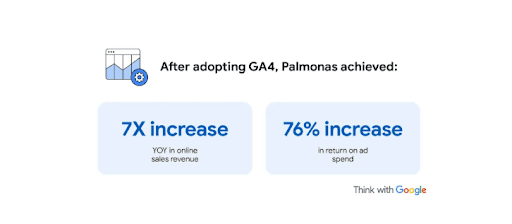
By adopting Google Analytics 4, Palmonas improved attribution and traffic quality.
Think with Google highlighted how data-driven insights helped the brand scale more efficiently, reducing guesswork and accelerating iteration.
Familiarity as a Trust Accelerator
Trust is critical in jewellery. Surveys suggest that over 55% of consumers hesitate to buy jewellery online due to quality concerns.
Palmonas reduced this friction through familiarity and consistency. A relatable public-facing co-founder strengthened credibility and made the brand feel safe and approachable.
In trust-heavy categories, familiarity can significantly increase repeat intent and long-term loyalty.
Offline Stores as Proof, Not Discovery
Palmonas expanded offline only after digital demand was validated.
Digital-First vs Offline-First Expansion
Offline-First Brands | Palmonas’ Approach |
High upfront cost | Demand validated digitally |
Discovery-led stores | Confirmation-led stores |
Slower learning | Faster iteration before scale |
Lower initial conversion | Higher intent walk-ins |
Research shows that offline stores perform 1.5x better when customers already know the brand. For Palmonas, stores reinforced trust and enabled try-before-buy experiences rather than acting as discovery channels.
Why Palmonas Achieved High Frequency
Palmonas did not grow because it sold jewellery. It grew because it changed how often and why jewellery is bought.
Their success was driven by:
- Reframing jewellery as daily fashion
- Creating a new category to reset expectations
- Designing products for repeat use
- Pricing for habit, not hesitation
- Sequencing digital and offline growth correctly
The core lesson is simple yet powerful. In mature markets, growth does not always come from selling more. It comes from changing consumer behaviour. Palmonas succeeded by understanding modern Indian women deeply and building a business around frequency, trust, and everyday relevance.