Gundeep Singh Grover is a seasoned digital strategist, entrepreneur, and thought leader with over a decade of expertise in driving exponential growth for businesses across the globe. As the co-founder of KingsDigital, he has successfully scaled the agency from a two-person team to a powerhouse of 20+ professionals, working with 170+ businesses worldwide.
Many websites struggle with SEO not because they lack content, but because they spend time optimising the wrong pages. Traffic increases, but enquiries and sales do not. This happens when optimisation is driven by guesswork instead of intent and data.
The real goal of SEO is not ranking more pages.
The goal is improving pages that can directly contribute to business growth.
This article explains a clear, step-by-step framework to identify which website pages should be optimised first, why those pages matter, and how to execute SEO in a structured and measurable way.
Before optimising any page, it is important to understand how users search when they are ready to take action. Not every search indicates a buying mindset. Some searches are purely informational, while others show clear commercial intent.
The first step is to isolate keywords that signal purchase or enquiry behaviour.
→ Open Google Search Console
→ Go to Performance → Search results
→ Set date range to last 3–6 months
→ Click + New → Query
→ Choose “contains”
→ Add buying-intent words
→ Export each filtered keyword list separately
This process removes curiosity-based searches and keeps only queries from users who are closer to conversion. These users are comparing options, evaluating prices, or looking for service providers.
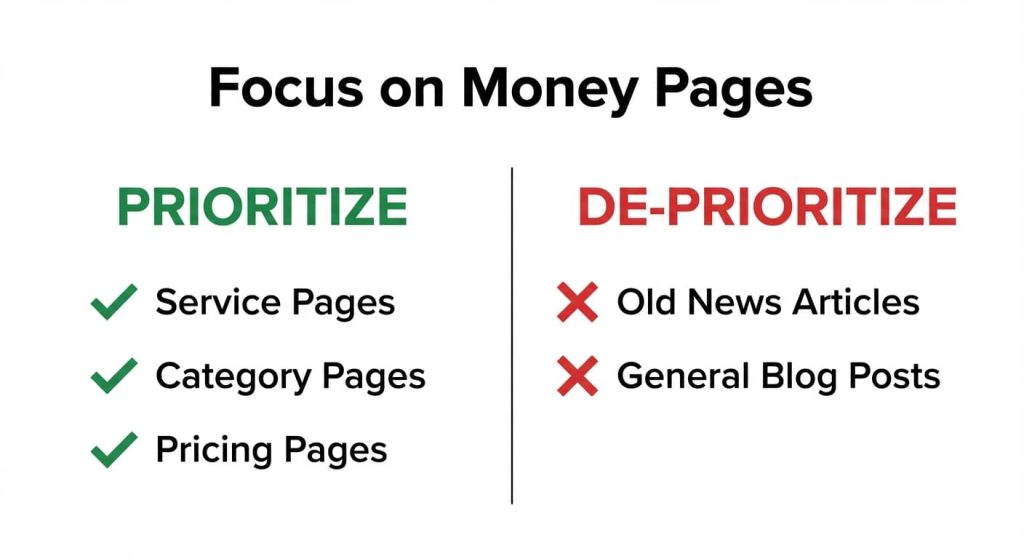
Once buying-intent keywords are identified, the next step is deciding where to focus optimisation efforts. A common mistake is trying to improve too many pages at the same time, which reduces impact.
SEO works best when attention is limited to a small number of high-value pages.
→ In Google Search Console
→ Go to Pages
→ Sort by Clicks or Impressions
→ Identify pages aligned with buying intent
Improving three to five high-impact pages produces faster and more visible results than spreading effort across dozens of URLs.
SEO analysis becomes ineffective when teams jump between pages without completing the work on any single one. A structured approach requires deep focus on one page before moving to the next.
This step helps uncover hidden opportunities that already exist.
→ GSC → Pages
→ Select one priority page
→ Switch to Queries
→ Export up to 1,000 keywords
→ Keywords ranking on page 2
→ High impressions but low clicks
Google already associates these keywords with the page. Small improvements in content structure, relevance, or clarity can move these keywords into higher positions without creating new pages.
Not every keyword deserves its own page. At the same time, forcing multiple intents onto one page can reduce clarity and performance.
The decision should be driven by search intent, not assumptions.
→ Search both keywords on Google
→ Compare:
This avoids keyword cannibalisation and ensures every page has a single, clear purpose.
Main pages rarely rank in isolation, especially in competitive markets. Supporting content plays a key role in strengthening authority and relevance.
Creating related blog content helps search engines understand topic depth.
→ Select one main page
→ List 5–10 related subtopics
→ Create blog content for each
→ Internally link all blogs to the main page
Supporting content sends strong relevance signals and helps capture long-tail searches while reinforcing the authority of the main page.
Before pushing further optimisation, it is critical to confirm that technical and on-page fundamentals are in place. Even strong content will underperform if basics are missing.
→ Page is indexed
→ Keyword present in:
→ Page loads under 3 seconds
→ No noindex or blocking rules
Technical issues prevent search engines from properly understanding and ranking pages
Target keyword → Digital marketing services in Canada
Page title → Our Solutions
→ Mismatch reduces visibility
When pages fail to move after optimisation, the issue is often authority, not content quality. Comparing your page with top-ranking competitors reveals what is missing.
→ Compare your page with top 3 results
→ Review:
→ Content gap → Improve content
→ Authority gap → Build mentions and links
Internal links help search engines understand which pages matter most. Priority pages should be easy to reach.
→ Use Screaming Frog
→ Analyse:
→ Priority pages within 1–2 clicks from homepage
Where to add links
SEO delivers consistent results when treated as an iterative process, not a one-time task.
Working in structured sprints allows teams to measure impact and refine strategies.
→ Select 5–10 pages
→ Optimise and publish
→ Wait 30–60 days
→ Review performance
→ Improve again
SEO growth comes from repetition, measurement, and refinement.
Effective SEO is not about optimising everything.
It is about making intent-driven, focused decisions.
Starting with buying-intent keywords, prioritising high-value pages, analysing one page at a time, fixing fundamentals, and working in structured sprints, businesses can turn SEO into a reliable growth channel rather than an ongoing experiment.
The difference between slow SEO and successful SEO is not effort.
It is focus, clarity, and execution.
Optimising all pages at once spreads effort too thin and delays results. Not every page contributes to business growth. By focusing only on pages with buying intent, you improve rankings faster and generate measurable leads or sales.
SEO works best when effort is concentrated on a few high-impact pages instead of many low-value ones.
Buying-intent keywords are search terms used by people who are ready to purchase or enquire about a service. These keywords often include words like services, pricing, cost, hire, or buy.
They are important because users searching with this intent are closer to conversion, making them more valuable than purely informational searches.
You should prioritise only three to five pages at a time. This allows you to analyse each page deeply, fix issues properly, and measure results clearly.
Working on too many pages at once reduces focus and makes it difficult to identify what is actually driving improvement.
A new page should be created when two keywords have different search intent. If Google shows different types of results for each keyword, they likely require separate pages.
If search results are similar and user intent matches, updating a single page is usually the better option.
Rankings may stay stuck due to lack of authority rather than content quality. If competitors have stronger backlinks, mentions, or trust signals, adding more content alone will not help.
In such cases, the focus should shift toward improving authority through internal linking, references, and external mentions.