
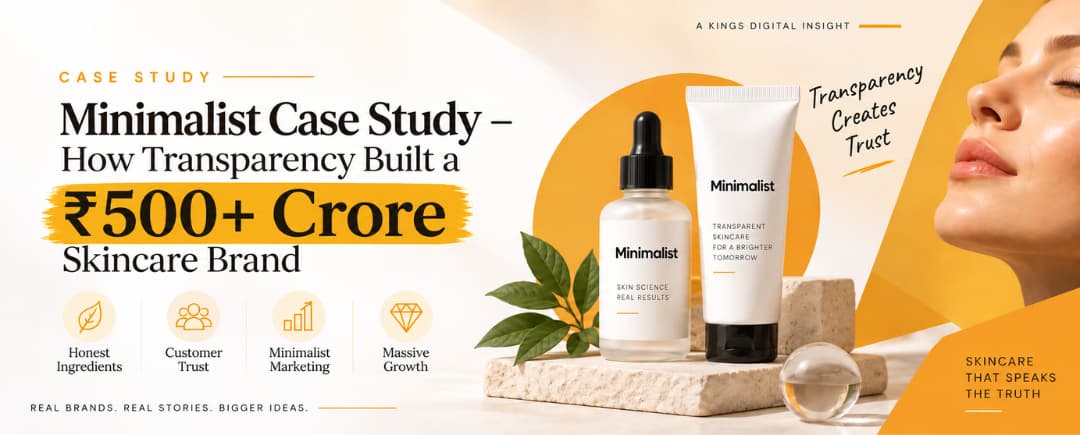



The Indian skincare market is crowded. New brands compete not only on products and prices but also on influencers, advertisements, packaging, claims, and social media visibility.
Yet Minimalist entered this highly competitive space in 2020 and managed to create a very different identity.
Instead of selling perfect skin, glamour, or unrealistic beauty promises, Minimalist made ingredients the centre of its communication.
A bottle was no longer simply a "brightening serum." It became a "10% Niacinamide Serum." Consumers could see what they were buying, why the ingredient was there, and what problem it was designed to address.
That simple shift became one of the strongest parts of Minimalist's business and marketing strategy.
Brand Strategy Case Study
Today, the story of Minimalist is not just a skincare success story. It is an interesting case study in positioning, consumer trust, product-led growth, content marketing, D2C distribution, and brand building.
Minimalist Brand Overview
Minimalist was founded by brothers Mohit Yadav and Rahul Yadav and launched in 2020. The company entered the market during the COVID-19 period, when consumers were spending more time online and becoming increasingly interested in understanding skincare ingredients.
The company describes itself as a high-performance skincare brand rooted in scientific research. Its stated philosophy centres on transparency, effective formulations, and helping customers make better-informed skincare decisions.
Minimalist entered a market where established companies already had years of distribution strength, consumer recognition, advertising budgets, and retail presence.
One industry estimate valued India's skincare products market at approximately ₹129.76 billion in 2020, with further growth expected during the following years.
— Industry market estimate, 2020Minimalist therefore did not enter an empty category.
It entered a category where consumers had hundreds of choices but were beginning to ask a different question:
"What exactly am I applying to my skin?"
That question became an opportunity.
The Market Problem Minimalist Identified
Traditional beauty brand marketing often focused heavily on the final outcome.
Consumers were shown glowing skin, attractive models, emotional advertisements, celebrity endorsements, premium packaging, and broad promises such as brighter, clearer, younger-looking, or more beautiful skin.
But the modern skincare buyer was changing.
People were beginning to search for terms such as niacinamide, retinol, salicylic acid, vitamin C, hyaluronic acid, AHA, BHA, pigmentation treatments, acne treatments, and skin barriers.
The conversation was moving from:
"Which cream should I buy?"
to:
"Which ingredient does my skin actually need?"
Minimalist positioned itself directly inside this change.
| Traditional Beauty Approach | Minimalist Opportunity |
|---|---|
| Outcome-focused claims | Ingredient-focused communication |
| Celebrity-led trust | Product and science-led trust |
| Complex labels | Clear ingredient information |
| Emotional beauty messaging | Functional skincare education |
| Aspirational product names | Active ingredient-based names |
| Brand tells consumers what to buy | Brand helps consumers understand why |
This gave Minimalist a clear point of difference.
It was not simply another skincare company selling serums.
It was selling clarity in a category filled with confusion.
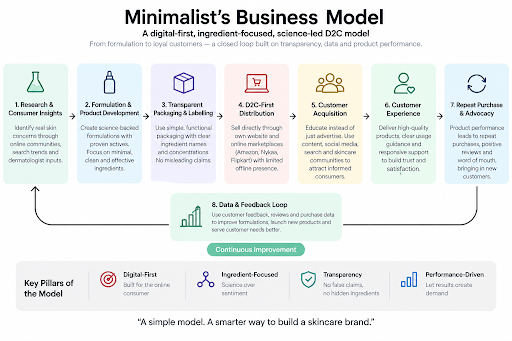
Minimalist's Business Model
Minimalist was built as a digital-first consumer brand.
Being digital-first allowed the company to sell directly, collect feedback quickly, observe customer behaviour, test products, understand demand, and use consumer data more efficiently than a purely offline business.
Mohit Yadav has previously explained that one advantage of building digitally was being able to understand what customers were saying about products and use those insights to improve the business.
Its model can be understood through four ideas:
Digital-first + science-led + ingredient-focused + consumer-feedback driven.
But the most important part was positioning.
Minimalist's philosophy was built around #HideNothing.
Rather than hiding key information behind attractive product names, the brand placed ingredients and concentrations at the centre of the product.
Consider the difference.
A conventional brand might market something as:
"Ultimate Clear Skin Glow Serum."
Minimalist could instead communicate:
"10% Niacinamide Serum."
The second approach tells an informed buyer much more about what they are purchasing.
This created a strong connection between product development and marketing.
The product itself became part of the communication.
Minimalist Marketing Strategy
One of the most interesting parts of the Minimalist case study is how closely its marketing matched its product strategy.
Minimalist did not need to invent an unrelated advertising personality.
Its marketing message came directly from what the company wanted its products to represent.
Transparency. Science. Ingredients. Performance.
This made its positioning easier to recognise.
Education Before Promotion
Minimalist understood that active-ingredient skincare creates questions.
What percentage of niacinamide should someone use?
Can vitamin C and retinol be used together?
What is salicylic acid?
What should someone use for pigmentation?
How does a chemical exfoliant work?
Every question creates a content opportunity.
Instead of only pushing "Buy Now," an education-led brand can explain the problem, ingredient, routine, usage method, and expected outcome.
This is an important part of Minimalist's marketing model.
Education reduces uncertainty.
Reduced uncertainty can increase trust.
And trust makes purchase decisions easier.
Scientific Naming Became Marketing
Minimalist's product naming strategy also works as a marketing tool.
Names containing active ingredients and concentrations immediately communicate functionality.
A customer does not have to decode a poetic product name to understand the basic proposition.
This is particularly powerful in search-led commerce.
A person searching online for "10% niacinamide serum" is already expressing product intent.
If the brand uses similar terminology in product names, pages, marketplace listings, educational content, and search optimisation, product language and consumer search behaviour become closely connected.
That can help both discoverability and conversion.
Product-Led Growth Before Aggressive Scale
Minimalist's early growth story should not simply be described as "no advertising."
A more accurate interpretation is that product, transparency, education, customer experience, and word of mouth played an unusually important role in creating initial trust.
Mohit Yadav has said that early customers spreading the word helped the company grow and that word of mouth continued bringing customers to the brand.
Amazon India also quoted Yadav warning young brands against becoming overly focused on marketing at the expense of understanding customer needs.
That mindset explains much of the early strategy.
Minimalist first gave consumers a reason to care about the product.
Paid growth could then amplify something that already had demand.
That distinction matters.
Minimalist Growth Numbers
The financial growth shows how rapidly the strategy gained traction.
Minimalist reportedly generated around ₹21 crore in revenue in 2021, followed by approximately ₹108 crore in 2022 and ₹184 crore in 2023, representing roughly 70% year-on-year growth in FY23.
Minimalist Reported Revenue Growth
It is important to distinguish actual revenue from revenue run rate. Reports around Minimalist's early "₹100 crore" milestone often refer to annualised run rate or business scale rather than ₹100 crore of recognised revenue in its first year.
By FY2024-25, the story had become much larger.
Hindustan Unilever reported that Minimalist had crossed ₹500 crore in annual turnover, only a few years after launch.
The brand also achieved strong repeat behaviour. In an earlier interview, Mohit Yadav stated that more than 50% of customers were returning customers.
This is important because repeat purchase is particularly valuable in skincare.
If a consumer finds a serum, cleanser, sunscreen, or moisturiser that works for them, the relationship does not necessarily end after the first transaction.
A successful first purchase can become a cycle.
That improves customer lifetime value and reduces the brand's dependence on acquiring a completely new customer for every sale.
Phase-Wise Promotion Strategy of Minimalist
Minimalist's marketing strategy also changed as the company became larger.
The early-stage marketing requirements of a new D2C business are very different from those of a ₹500 crore brand.
| Phase | Main Objective | Marketing Focus |
|---|---|---|
| 2020–2022 | Build trust | Product education, ingredient transparency, community discussion, digital content and word of mouth |
| 2023–2024 | Scale demand | Performance campaigns, marketplace visibility, retargeting, digital video and larger media investments |
| Brand Maturity | Build recall and defend position | Broader brand advertising, premium media, new-category promotion and international growth |
Phase 1 – Trust Before Visibility
Between 2020 and 2022, Minimalist needed credibility more than mass awareness.
The consumer first had to understand why this brand was different.
Ingredient-focused labels, science-led information, skincare education, product reviews, digital communities, search behaviour, customer feedback, and word of mouth all supported that objective.
The message was simple:
Know what you are putting on your skin.
This created a strong foundation for organic discovery.
Phase 2 – Scaling a Proven Proposition
Once Minimalist had established product-market fit, returning customers, marketplace reviews, word of mouth, and stronger recognition, its marketing needs changed.
Paid acquisition became much more useful.
Financial reporting around FY23 shows that Minimalist was no longer a brand relying almost entirely on organic promotion. Advertising and promotional expenditure reportedly reached approximately ₹65 crore in FY23, roughly doubling from the previous year as the company scaled.
This is a major lesson from the case study.
The strategy was not:
"Never advertise."
It was closer to:
"Build something worth advertising first."
Phase 3 – Brand Maturity
At a larger scale, advertising performs another role.
The challenge is no longer simply convincing customers that the company exists.
Advertising can now strengthen recall, defend category share, introduce new product categories, reach larger audiences, support marketplaces, and build international awareness.
This is the point where performance marketing and brand marketing can work together.
The 4Ps of Minimalist
Product
Minimalist's strongest differentiator has always been the product proposition.
Its range includes products built around recognised skincare actives such as niacinamide, salicylic acid, retinol, hyaluronic acid, vitamin C and other targeted ingredients.
The packaging supports this strategy by giving functional product information strong visual priority.
Minimalist therefore turns product clarity into brand identity.
Instead of asking customers to trust an abstract beauty promise, it tries to make the formulation itself part of the reason to purchase.
Price
Minimalist largely follows what can be described as an affordable-premium or masstige strategy.
It does not compete primarily as the cheapest skincare brand.
At the same time, it makes active-led skincare more accessible than many premium international clinical brands.
Mohit Yadav has also described Minimalist as a masstige brand with affordable products.
This gives the company access to younger buyers who want better formulations but may not want to pay luxury skincare prices.
Place
Digital distribution has been central to Minimalist from the beginning.
Alongside its own website, the brand expanded through major online marketplaces and beauty-commerce channels.
Amazon became particularly important. In 2023, Amazon India reported that Minimalist was selling roughly seven products every minute globally through Amazon at that time.
This distribution model gives a D2C-led company several advantages.
It can observe customer demand quickly, collect reviews, test products, build first-party customer relationships through its own channel, and reach marketplace customers without first building an enormous physical retail network.
Minimalist has also expanded internationally. Earlier reporting identified markets including the UAE, US, UK, Malaysia, Nepal, Indonesia and Saudi Arabia, while the company's current website describes a presence across multiple continents and countries.
Promotion
Minimalist's most distinctive promotional idea can be summarised in three words:
Teach before selling.
Ingredient explainers, product education, scientific communication, skincare routines, problem-focused content, marketplace reviews, expert-led discussion and consumer experiences all support the brand's position.
Paid media eventually became important too.
But promotion works because it reinforces the same idea already communicated by the product.
That consistency is one reason Minimalist has such a recognisable identity.
Why Did HUL Acquire Minimalist?
Minimalist's rise eventually attracted one of India's largest consumer-goods companies.
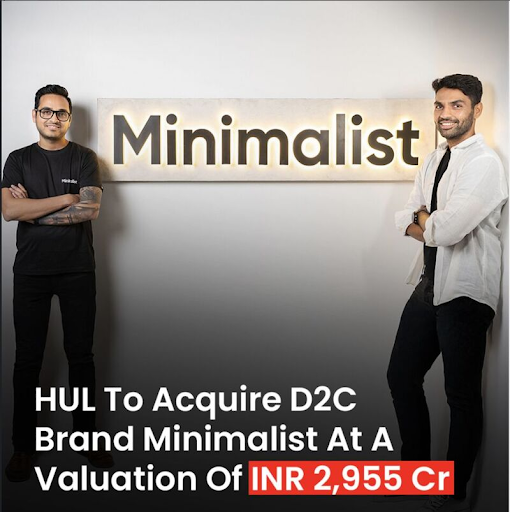
In January 2025, Hindustan Unilever announced an agreement to acquire 90.5% of Uprising Science Private Limited, the company behind Minimalist, with the remaining 9.5% intended to be acquired later.
The transaction valued the business at a pre-money enterprise value of ₹2,955 crore, subject to transaction adjustments.
The Competition Commission of India approved the acquisition in March 2025, and HUL reported that the acquisition of the 90.5% stake was completed on 21 April 2025.
Why was Minimalist attractive?
HUL already had enormous experience in beauty and personal care.
What Minimalist offered was different.
It brought a fast-growing digital-first business, a strong position in science-led skincare, younger online consumers, D2C capabilities, premiumisation potential, product credibility, marketplace strength and a brand identity built for the next generation of beauty shoppers.
HUL itself described Minimalist as a fast-growing digital-first brand sitting at the intersection of beauty and actives-led science.
In simple terms, HUL was not merely buying bottles of serum.
It was acquiring a modern consumer brand with an established audience, distinctive positioning and strong growth potential.
What Marketers Can Learn From the Minimalist Case Study
Minimalist shows that differentiation does not always come from louder advertising.
Sometimes it comes from identifying what consumers dislike about an entire category and building the company around fixing it.
| Marketing Lesson | What Minimalist Demonstrates |
|---|---|
| Trust can become positioning | Transparency can differentiate a brand |
| Education can drive demand | Helping buyers understand a category can support conversion |
| Product and marketing should connect | The product itself can communicate the brand promise |
| Community creates credibility | Customers talking about results can strengthen acquisition |
| Retention changes growth economics | Repeat customers can increase lifetime value |
| Performance marketing works better after product-market fit | Paid media can amplify existing demand |
| Clear positioning beats generic messaging | Consumers should quickly understand why a brand is different |
| Search behaviour can influence product communication | Ingredient-focused terminology can match high-intent searches |
| Transparency creates accountability | Clear claims require the product to deliver |
Final Insight
Minimalist's biggest achievement was not simply launching another skincare range.
It changed the basis on which it wanted consumers to evaluate skincare.
Instead of saying:
"Trust us because we are a beauty brand."
The message became:
"Here is what is inside the product. Understand it and decide."
That shift turned transparency into positioning, science into communication, education into marketing, and product performance into a growth engine.
Minimalist then followed a smart growth sequence.
First came differentiation → Then trust → Then customer adoption → Then retention → Then larger-scale advertising → Category leadership and acquisition.
The lesson for modern businesses is clear: marketing cannot permanently compensate for a weak product or unclear positioning. Strong growth often begins when a business identifies a genuine consumer frustration, communicates its solution clearly, earns trust and only then uses paid media to accelerate what is already working.
Minimalist's Journey at a Glance
Minimalist launched
Brand launch
Rapid early D2C adoption
₹21 Cr reported revenue
Strong product-market fit
₹108 Cr reported revenue
Accelerated scaling
₹184 Cr reported revenue
Crossed major business milestone
₹500 Cr+ annual turnover
HUL acquired 90.5% stake
₹2,955 Cr pre-money enterprise value
HUL-backed growth continues
₹850 Cr+ annual revenue run rate
For brands trying to build that kind of sustainable digital presence, Kings Digital helps connect strategy, SEO, content, performance marketing and digital growth so businesses can move beyond simply getting attention and start building authority, trust and measurable long-term growth.
Frequently Asked Questions
1. What made Minimalist successful in the Indian skincare market?
Minimalist succeeded by focusing on ingredient transparency, science-led formulations, simple product communication, and consumer education. Instead of relying only on beauty promises, the brand clearly explained what each product contained and what problem it was designed to solve. This helped it build trust among informed skincare buyers.
2. What is Minimalist's business model?
Minimalist follows a digital-first D2C business model. It sells through its own website and major online marketplaces while using consumer feedback, reviews, search behaviour, and purchase data to improve products and understand customer needs. Its model strongly connects product development, education, digital distribution, and repeat purchases.
3. What marketing strategy does Minimalist use?
Minimalist uses an education-led and product-focused marketing strategy. Its communication revolves around ingredients, formulations, skincare concerns, and product performance. As the brand grew, it also expanded into paid advertising, marketplace promotions, retargeting, digital video, and broader brand-building campaigns.
4. Why is ingredient transparency important to Minimalist?
Ingredient transparency helps customers understand what they are buying and why they may need a particular product. By clearly showing active ingredients and their concentrations, Minimalist reduces confusion and gives consumers more information before making a purchase decision.
5. How did Minimalist build customer trust?
Minimalist built trust through clear labelling, educational content, product-focused communication, customer reviews, word of mouth, and consistent messaging around science and transparency. Its approach helped move the brand away from traditional beauty marketing and toward more informed skincare decisions.
6. Why did HUL acquire Minimalist?
Hindustan Unilever acquired a majority stake in Minimalist because the brand had built a strong digital-first skincare business with rapid growth, premium positioning, science-led products, and a loyal online customer base. The acquisition also gave HUL stronger access to the fast-growing active skincare and digital beauty segment.
7. What can marketers learn from Minimalist?
The biggest lesson is that strong positioning can be more powerful than simply increasing advertising. Minimalist identified a real consumer problem, simplified its communication, educated buyers, built trust, encouraged repeat purchases, and then scaled its marketing. The brand shows how product, content, positioning, and performance marketing can work together.
8. Is Minimalist a product-led or marketing-led brand?
Minimalist is best described as a product-led brand supported by strong marketing. Its early differentiation came from formulations, ingredient transparency, and consumer education. Marketing later helped amplify demand and expand reach, but the product proposition remained at the centre of the brand.
9. How is Minimalist different from traditional skincare brands?
Traditional skincare brands often rely heavily on emotional messaging, aspirational beauty, celebrity promotion, and broad product claims. Minimalist focuses more on active ingredients, scientific explanations, functional product naming, and transparent communication.