
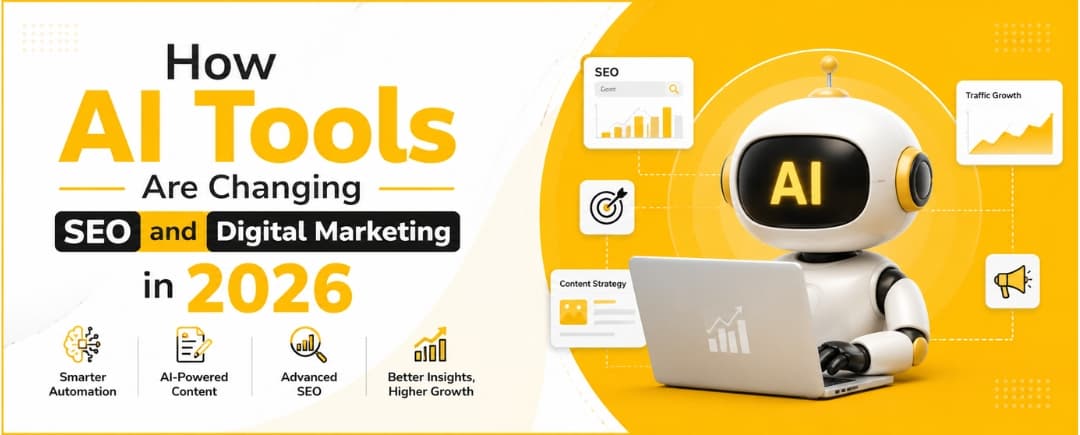


The world of digital marketing is changing very fast because of this technology. Businesses are now using AI to understand customer behaviour, predict trends, improve campaigns, and create better user experiences. Search engines are also becoming smarter. They now focus more on intent, trust, relevance, and real value instead of basic keyword matching.
This shift is forcing brands to rethink how they approach SEO and online growth.
The global AI market is expected to cross $300 billion in value within the next few years.
— StatistaMore than 75% of marketers already use AI tools in some part of their workflow.
— HubSpotThese numbers clearly show that AI is no longer optional in modern marketing.
Read this also: 10 Best Social Media Marketing Strategies for Beauty Brands
SEO Strategy
AI Is Transforming SEO Strategy
Traditional SEO focused heavily on keywords and backlinks. While those things still matter, search engines today understand context much better.
Google's AI systems now analyse:
- User intent
- Search behaviour
- Page quality
- Content depth
- Trust signals
- Engagement patterns
This means businesses can no longer rank with thin or repetitive content.
Modern SEO digital marketing now focuses on creating helpful content that answers real questions clearly. AI tools help marketers study search trends, identify gaps, and build stronger content strategies faster than before.
For example, AI platforms can now:
- Suggest keyword clusters
- Predict ranking opportunities
- Analyse competitor content
- Improve meta descriptions
- Detect technical SEO issues
- Recommend internal linking structures
These tools save time while improving accuracy.
Content Creation
Content Creation Has Become Faster and Smarter
One of the biggest changes in digital marketing services is AI-powered content creation.
Businesses now use AI tools for:
- Blog outlines
- Topic research
- Video scripts
- Social captions
- Product descriptions
- Email campaigns
- Ad copy generation
This does not mean human writers are disappearing. Instead, marketers are combining AI efficiency with human creativity.
AI helps reduce repetitive work, while human experts add strategy, emotion, and brand understanding.
For example, an eCommerce company may use AI to generate product content quickly, but editors still improve tone, clarity, and customer relevance before publishing.
This balance is becoming very important because search engines now reward authentic and useful content more than machine-generated spam.
Search Behaviour
Search Engines Are Becoming More Conversational
In 2026, search behaviour looks very different compared to a few years ago.
People are now searching using natural language questions like:
"Which marketing strategy works best for local brands?"
"How can I improve website traffic without paid ads?"
"What is the best SEO strategy for small business growth?"
AI-powered search engines understand these longer conversations much better.
Because of this, businesses must create content that sounds natural and answers questions directly.
This is changing the way every digital marketing agency creates SEO strategies.
Instead of focusing only on short keywords, agencies now build:
- Topic clusters
- FAQ-focused pages
- Conversational blogs
- Voice-search-friendly content
- GEO and AEO content structures
These methods help businesses appear in AI-generated search summaries and smart assistant responses.
Customer Targeting
AI Improves Customer Targeting
AI is also making advertising smarter.
Earlier, marketers had to guess audience interests based on limited data. Today, AI systems analyse huge amounts of information in real time.
AI tools can now study:
- User behaviour
- Purchase history
- Website activity
- Device usage
- Search intent
- Social media engagement
This helps brands deliver more personalised campaigns.
For example, streaming platforms like Netflix and shopping websites like Amazon already use AI recommendation systems heavily. Similar strategies are now becoming common in digital marketing campaigns as well.
Businesses can now show personalised:
- Ads
- Product suggestions
- Email campaigns
- Website experiences
- Retargeting messages
This improves engagement and conversion rates significantly.
Personalised marketing powered by AI can increase customer engagement by up to 40%.
— McKinseyThat is a major advantage for businesses competing online.
Data Analysis
AI Tools Are Improving Data Analysis
Marketing produces huge amounts of data every day. Earlier, analysing this data manually took a lot of time.
Now AI tools can process large datasets within seconds.
This helps marketers understand:
Advanced digital marketing services now rely heavily on predictive analytics.
AI can even forecast future trends by studying historical patterns. This helps businesses make smarter decisions earlier.
For example, if AI notices rising searches around a specific topic, brands can create content before competitors react.
This gives businesses a strong SEO advantage.
Automation
Automation Is Saving Time and Cost
Another major change is automation.
Many repetitive marketing tasks are now automated using AI systems.
Examples include:
Automated delivery of the right message at the right time
Instant responses to customer queries around the clock
Automatic ranking of prospects by conversion likelihood
Scheduled publishing across platforms without manual effort
Real-time dashboards generated without manual data entry
Continuous campaign adjustments to maximise ROI
This allows teams to focus more on strategy and creativity instead of manual work.
For small businesses, this is especially helpful because they can now access advanced tools without building large marketing departments.
A modern digital marketing agency often combines automation with human strategy to improve efficiency while maintaining quality.
Trust & Authority
Trust and Human Value Still Matter
Even though AI is growing rapidly, human trust remains very important.
Search engines are now focusing more on:
- Expertise
- Experience
- Authority
- Transparency
This means businesses cannot depend only on automation.
People still connect with real experiences, strong storytelling, and clear communication. AI may help organise information, but human understanding still shapes meaningful content.
Brands that use AI responsibly while maintaining authenticity are likely to perform best in the future.
This is why many companies now focus on combining:
- AI technology
- Human creativity
- SEO expertise
- User experience
- Brand trust
This balanced approach is becoming the future of SEO digital marketing.
Future Trends
The Future of AI in Digital Marketing
AI will continue changing marketing in the coming years. New search experiences, smarter algorithms, and predictive systems will reshape how people discover brands online.
Businesses that adapt early will gain stronger visibility and better customer relationships.
The future of digital marketing will likely focus more on:
- AI search optimisation
- Voice search
- Predictive analytics
- Hyper-personalisation
- Visual search
- Conversational SEO
- Automated customer journeys
Companies that ignore these changes may struggle to compete online.
Read this also: 10 ways to get more followers on Social Media
AI tools are transforming SEO and online growth faster than ever before. From smarter content creation to advanced customer targeting, businesses now have access to technology that improves both efficiency and performance. However, success still depends on creating valuable content, understanding customer needs, and building trust over time.
Modern digital marketing services are no longer only about rankings or advertisements. They now combine AI technology, search strategy, data analysis, and user experience into one complete growth system. Businesses looking to stay ahead in 2026 are increasingly partnering with agencies like Kings Digital that understand how AI-driven SEO digital marketing is shaping the future of online visibility and business growth.
Frequently Asked Questions
AI is improving digital marketing by helping businesses automate tasks, analyse customer behaviour, create content faster, and improve campaign performance more accurately.
Yes, AI tools help improve SEO digital marketing by finding keyword opportunities, analysing competitors, tracking rankings, and optimising content for search intent.
Businesses use digital marketing services powered by AI because they save time, improve targeting, increase efficiency, and help generate better marketing results.
No, AI supports marketers by handling repetitive work, but human creativity, strategy, emotional understanding, and decision-making are still very important.
Businesses should focus on helpful content, user experience, AI search optimisation, trust-building, mobile performance, and audience-focused SEO strategies.