Home / Blog / Social Media
Ritesh Agrawal has spent more than 12 years helping companies in the USA, UK, UAE, Australia, Canada, and India grow faster, stronger, and smarter. He is not just an advertiser. He is an entrepreneur who knows how to turn ideas into revenue and campaigns into long-term growth.
Vanity metrics are the numbers that look like success:
→ Impressions
→ Views
→ Likes
→ Followers
→ Reach
→ Pageviews
They make reports feel upbeat. They also make teams feel busy and effective.
But the real problem is not that these metrics are “wrong.” The real problem is that they can be technically true and still strategically useless.
KPI | Target | Actual | Status | Insight |
Revenue Attributed to Marketing | ₹X | ₹Y | 🟢 / 🔴 | Trend vs last period |
Customer Acquisition Cost (CAC) | ≤ ₹X | ₹Y | 🟢 / 🔴 | Rising or stable |
Return on Ad Spend (ROAS) | ≥ X | Y | 🟢 / 🔴 | Channel-driven |
Conversion Rate (Overall) | ≥ X% | Y% | 🟢 / 🔴 | Funnel health |
Marketing % of Revenue | ≤ X% | Y% | 🟢 / 🔴 | Efficiency signal |
When vanity metrics become the headline KPI, they pull campaigns toward visibility instead of value. Over time, you can end up “winning” on dashboards while losing on revenue, retention, and profit.
A major reason vanity metrics keep dominating is measurement confusion.
Nielsen’s 2023 Annual Marketing Report found 62% of marketers find it hard to know where to use ad budgets to reach specific audiences, and 69% say digital media and audience fragmentation creates significant challenges.
When marketers are unsure, they default to the easiest numbers available. And platforms make “big numbers” very easy to access.
OWOX, citing DMA data, reports that 39% of tracked metrics were limited to campaign delivery and digital vanity metrics, and 34.2% of companies rarely or never measure marketing ROI.
That is not just a reporting choice. It is an accountability gap.
A core reason vanity metrics mislead is that they measure exposure, not human attention or business effect.
Take “impressions.” An impression often means only that an ad was served. It does not guarantee it was seen, noticed, or processed.
Nielsen has pointed out that only about 50% of online ads are “viewable”, meaning roughly half are never in a position where they could realistically be seen.
And even “viewable” is not the same as “viewed.” The IAB/MRC viewability standard for display is typically 50% of pixels in view for 1 second, and for video 50% of pixels for 2 seconds.
That threshold is a technical minimum—useful for ad transactions—but it does not prove persuasion.
Why it matters: If your campaign report celebrates 5 million impressions, you may be celebrating distribution mechanics, not customer influence.
Vanity metrics are dangerous because they produce a strong emotional signal: “numbers went up.” Teams then assume the strategy worked and scale it.
Example: a brand runs a viral short-form video campaign.
Reported success (vanity):
Hidden reality (business):
This is common because engagement can be driven by entertainment value, controversy, curiosity, or trend-hopping—none of which guarantees buying intent.
When leadership green-lights “more of the same” based on reach and engagement alone, you often scale the wrong creative and the wrong audience.
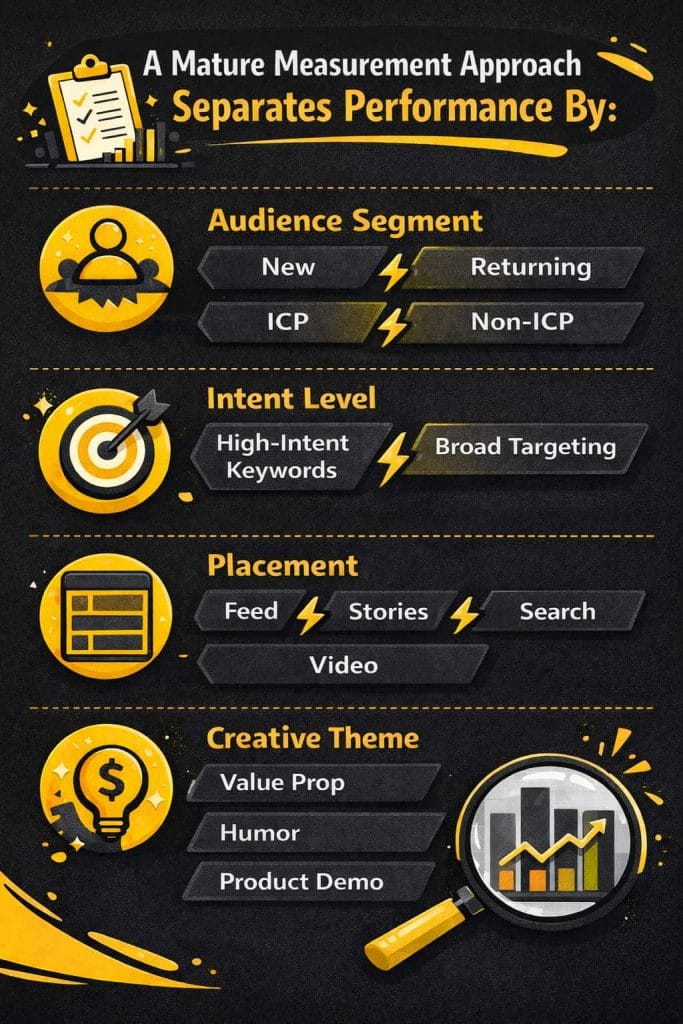
Two campaigns can generate the same number of clicks, but the quality of those clicks can be totally different.
If you report only:
…you are ignoring the difference between curious people and qualified buyers.
Vanity metrics rarely force that discipline.
Many teams still treat the last touch as the “winner.” That makes vanity metrics even more misleading, because they live mostly in upper funnel activity.
Google explicitly explains that model comparison can reveal keywords/campaigns that are undervalued under last-click, and that data-driven attribution (DDA) distributes credit across the conversion path.
In Google’s own reporting, advertisers who switch to data-driven attribution typically see an average 6% increase in conversions.
That 6% is important because it shows a real pattern: when you measure more accurately, you often invest differently—and performance improves.
In plain terms: Vanity metrics are easiest at the top of the funnel, but value is often created across multiple touches. If you only measure top-funnel volume or last-touch credit, you will optimise for the wrong thing.
Instead of banning vanity metrics, treat them as context, not proof. Here is a practical value ladder:
Awareness (context metrics)
Awareness → Engagement
Metric | Why It Exists | Good Signal | Red Flag |
Reach (Unique) | Distribution scale | Growing unique reach | High frequency, low reach |
Frequency | Ad fatigue indicator | 2–4 range | >6 consistently |
Viewability Rate | Real exposure | >70% | <50% |
CTR (Click-Through Rate) | Message relevance | Improving trend | Flat despite reach |
Engagement (quality of interaction)
Engagement → Intent
Metric | Why It Matters | What It Tells You |
Engaged Sessions | Real interest | Bounce-proof traffic |
Avg. Time on Page | Content quality | Scanning vs reading |
Scroll Depth (%) | Message absorption | CTA visibility |
Video Watch Time | Attention quality | Views ≠ persuasion |
Insight rule: High traffic + low engaged sessions = wrong audience or weak promise
Conversion (business outcomes)
Intent → Conversion (Non-Negotiable Section)
KPI | Formula | Insight |
Conversion Rate | Conversions ÷ Sessions | Funnel health |
Cost per Conversion | Spend ÷ Conversions | Efficiency |
Lead → MQL % (B2B) | MQLs ÷ Leads | Lead quality |
Add-to-Cart Rate (Ecom) | ATC ÷ Sessions | Product relevance |
Checkout Completion | Purchases ÷ Checkouts | UX friction |
Insight rule: High traffic + low engaged sessions = wrong audience or weak promise
Profit & long-term impact
This ladder forces you to answer: “Is attention turning into action, and is action turning into profit?”
A strong strategy does not say “stop tracking impressions.” It says:
“If impressions went up, what moved downstream?”
Examples of translation rules:
This is how you keep your reports honest.
Vanity Metric | Must Be Paired With | Why |
Impressions | Viewability + Frequency | Real exposure |
Views | Watch Time + CTR | Attention depth |
Likes | Clicks + Assisted Conversions | Business intent |
Followers | Profile CTR + Revenue Assist | Audience value |
Traffic | Revenue per Visitor | Quality check |
If a metric cannot influence a decision, it does not belong on the dashboard.
Vanity metrics are not the enemy. Misusing them as the definition of success is the enemy. They measure exposure, not impact.
They can inflate confidence, hide audience quality problems, and distort attribution and budget allocation especially in fragmented digital ecosystems where marketers already struggle to measure consistently.
The most effective teams still track reach and engagement, but they treat them like early signals not final answers.
Real measurement connects marketing activity to conversion, cost efficiency, and profit over time. And when measurement improves, results often improve too Google’s data-driven attribution lift is one example of that pattern in action.