
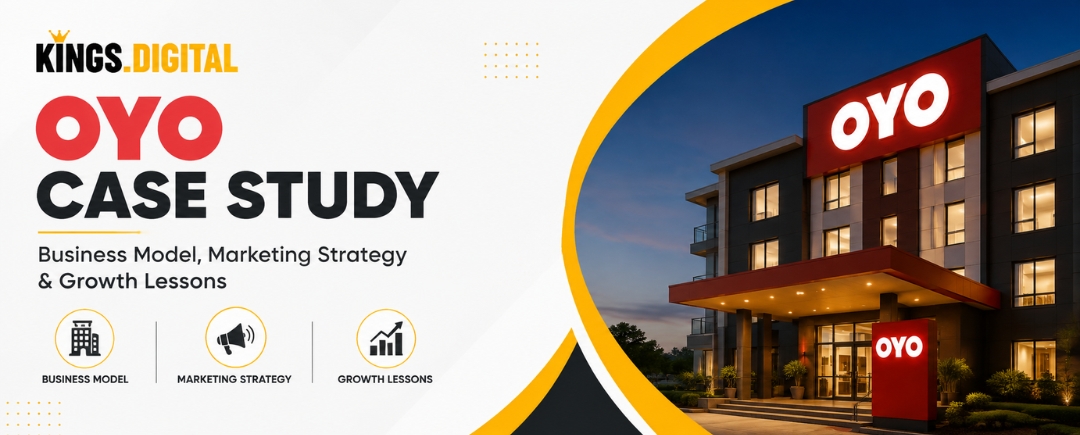



OYO Case Study: How a Teenager Found a Gap in India's Hotel Market and Built a Global Brand
| Area | Details |
|---|---|
| Founder | Ritesh Agarwal |
| Original company | Oravel Stays |
| OYO launch | 2013 |
| First OYO property | C68, South City 1, Gurugram |
| Main customer problem | Budget hotels were affordable but quality was unpredictable |
| Hotel-owner problem | Low occupancy, weak online visibility and poor pricing systems |
| OYO's solution | Branding, standardisation, technology, pricing and online bookings |
| Early business model | Commission on bookings from partner hotels |
| Later model | Franchising, managed hotels, leases, vacation homes and listings |
| Main strength | Fast, asset-light expansion |
| Main mistake | Expanding faster than service quality and partner relationships could support |
| Current direction | Profitable growth, premium brands, technology and global hospitality |
OYO officially states that its first branded property opened in 2013 with hotel partner Rajesh Yadav at C68, South City 1, Gurugram.
Great businesses aren't built by chance. Discover how Kings Digital combines branding, digital marketing, and lead generation to help businesses grow with confidence.
1. Who Is Ritesh Agarwal?
Ritesh Agarwal grew up in Odisha. He was interested in computers, coding, business and technology from a young age. After school, he moved to Delhi but did not follow the normal college-to-job route.
Travel played an important role in shaping his business idea. According to OYO, he travelled across India at around 17 years of age and stayed in more than 100 guest houses, bed-and-breakfast properties and small hotels.
During these trips, he noticed something strange.
India had plenty of low-cost hotels. However, customers could not easily know what they would receive after reaching the property.
A hotel might look good in photographs but have:
- Dirty bedsheets
- An unhygienic washroom
- Poor room lighting
- Broken air conditioning
- Untrained staff
- No proper booking records
- A price that changed at check-in
- Services that were completely different from the online description
The issue was therefore not just the number of hotels. The issue was trust. This insight became the foundation of a digital marketing strategy and branding strategy that helped OYO create a trusted name in India's fragmented hotel industry.
The issue was trust.
Ritesh later explained that travellers were not struggling to discover budget hotels. They were struggling to trust them. One stay could be comfortable, while the next could be disappointing despite having a similar price.
This became the central insight behind OYO.
2. OYO Started as Oravel Stays
Before OYO, Ritesh created Oravel Stays.
Oravel was closer to a booking marketplace. Its purpose was to help travellers discover and book small hotels, guest houses and vacation properties.
The concept was inspired by the growing online accommodation marketplace model. Property owners could list their spaces, and travellers could find them online.
However, Ritesh soon understood that simply listing a bad or inconsistent hotel online did not solve the customer's real problem.
Imagine a hotel has:
- Poor-quality rooms
- Untrained employees
- Weak housekeeping
- No fixed standards
- Bad customer support
Putting that hotel on a website may increase its visibility, but it does not automatically improve the guest's stay.
This was the weakness in the first idea.
Oravel was solving hotel discovery. Customers needed reliability.
That realisation caused the company to pivot and develop a stronger marketing strategy for business focused on customer trust rather than simply increasing hotel listings.
3. The Critical Pivot from Oravel to OYO
A pivot happens when a startup changes its main product or business model after learning that the original approach is not solving the complete problem.
Ritesh changed the idea from:
"Let us help people find budget hotels."
"Let us improve budget hotels, standardise them and then help people book them."
That was the difference between Oravel and OYO.
OYO began partnering with independent hotel owners. The hotels continued to belong to their existing owners, but OYO helped improve the customer experience.
The company worked on areas such as:
- Room quality
- Clean bedsheets
- Washroom hygiene
- Basic toiletries
- Wi-Fi and television availability
- Staff training
- Hotel photography
- Online bookings
- Pricing
- Customer service
- Property branding
In its early model, OYO placed its brand on partner hotels, trained their staff and attempted to deliver a similar basic experience across different locations. A 2017 Forbes India report stated that OYO was receiving approximately 20% commission on booking value at that stage.
This was not exactly the same as building a traditional hotel chain.
Companies such as Marriott traditionally grew by managing, franchising or owning large hotel properties. OYO applied a simplified branding and technology system to small, independent budget hotels.
4. How Did Ritesh Know the Idea Would Work?
Ritesh did not know with complete certainty that OYO would become successful. No founder does.
He found evidence step by step.
First evidence: He experienced the problem himself
The idea did not come only from sitting in an office or reading a market report. He personally stayed in more than 100 small properties.
That gave him direct knowledge of what guests disliked.
He saw that the same problems appeared repeatedly in different cities. This meant it was not one hotel's problem. It was a market-wide problem.
Second evidence: Both sides needed help
A strong marketplace normally solves problems for two groups.
Travellers needed:
- Affordable rooms
- Reliable quality
- Simple booking
- Transparent prices
- Customer support
- A brand they could recognise
Hotel owners needed:
- More bookings
- Better occupancy
- Online visibility
- Professional photographs
- Pricing support
- Technology for managing rooms
- A recognisable brand
This created a strong two-sided opportunity supported by a well-planned digital marketing strategy that benefited both travellers and hotel owners.
OYO could tell travellers, "You can trust this property," while telling hotel owners, "We can bring you more customers."
Third evidence: The first hotel acted as a live experiment
The first OYO opened in Gurugram in 2013. Instead of trying to sign thousands of hotels immediately, the early team could test its idea on one property.
They could observe:
- Did better photographs increase enquiries?
- Did room improvements increase ratings?
- Did customers book again?
- Did online pricing improve occupancy?
- Did the hotel owner earn more?
- Would guests trust the OYO name in another location?
This small pilot provided more valuable information than a large theoretical business plan.
Fourth evidence: Hotel occupancy reportedly increased
Ritesh claimed that hotels joining OYO could move from approximately 20–25% occupancy to 70–80% occupancy within 45–90 days. These figures were the founder's claim rather than independently audited results for every property, but they explain why owners were willing to join the network.
Even if results differed between hotels, the basic value was clear: an empty room earns nothing. If OYO brought additional bookings, hotel owners could share part of that revenue and still earn more than before.
Fifth evidence: The model could be repeated
One successful hotel is a business.
A process that can improve hundreds of hotels is a scalable business model.
OYO created checklists, technology, branding systems, training methods and pricing tools that could be applied to multiple properties.
This repeatability helped OYO expand quickly.
Whether you need SEO, paid advertising, branding, or lead generation, Kings Digital delivers tailored digital marketing solutions designed for long-term business success.
5. Why Was India the Right Market for OYO?
India had several conditions that made the idea suitable.
A highly fragmented hotel market
Most small hotels were independent family-run businesses. They did not have the money or knowledge required to create a strong national brand.
Even today, OYO's 2026 prospectus states that around 92% of Indian hotel storefronts were unorganised in 2025. This shows how large the fragmented market remains.
Growing domestic travel
People were travelling for:
- Business
- Exams
- Medical treatment
- Family functions
- Pilgrimages
- Weddings
- Short holidays
- Government work
- Job interviews
Many of these travellers did not need a luxury hotel. They wanted a clean, safe and reasonably priced room.
Lack of trusted budget brands
India had premium hotel names, but the lower-price segment was largely unbranded.
A traveller could recognise a Taj or Marriott, but a small hotel near a railway station or business area usually had no recognised identity.
OYO placed one common brand across these properties.
Rising smartphone and internet usage
As online payments, mobile applications and travel websites became more common, customers became more comfortable booking rooms digitally.
OYO launched its app in 2015. By that year, it had expanded to 100 cities and crossed 10,000 rooms, according to the company's timeline.
Hotel owners lacked technology
Many small hotels managed bookings through notebooks, telephone calls or basic spreadsheets.
They often did not know:
- What price to charge on a busy weekend
- Which online platform delivered bookings
- How many rooms would remain empty
- How to respond to online reviews
- How to manage cancellations
- How to improve their ranking
OYO used technology to support these decisions while building a scalable marketing strategy for business that improved hotel visibility and operational efficiency.
Read this article: Social Media Marketing Strategies for Beauty Brands
6. How the OYO Business Model Worked
Many people think OYO purchased all the hotels carrying its name. That is incorrect.
OYO largely followed an asset-light model.
This means the company could grow without purchasing every hotel building. Independent owners supplied the physical properties, while OYO supplied the brand, technology and customer demand.
OYO PROVIDED HOTEL PARTNERS WITH
- Branding
- Online distribution
- Pricing technology
- Revenue-management tools
- Hotel-management software
- Customer support
- Staff training
- Room-quality guidance
- Marketing
- Access to corporate and individual travellers
HOTEL PARTNERS PROVIDED
- The property
- Rooms
- Local employees
- Daily operations
- Housekeeping
- Maintenance
- Guest service
OYO earned money through:
- Booking commissions
- Franchise or royalty fees
- Revenue sharing
- Accommodation services
- Lease-related income
- Subscription and listing fees
- Management services
- Other guest and property services
Today, the business is more complex than the original OYO Rooms model. Its 2026 prospectus describes three main verticals: hotels, professionally managed homes and fixed-fee listings. The company also operates wedding, workspace, event and food-related services.
7. OYO's Growth Strategy
OYO's rapid growth came from several connected strategies.
Standardise the basics, not luxury
OYO did not initially promise a five-star experience.
It focused on things that budget travellers cared about most:
- Clean room
- Working washroom
- Comfortable bed
- Air conditioning where promised
- Television and Wi-Fi
- Simple check-in
- Reasonable price
This made the promise easier to understand.
Use one brand across many independent properties
Small hotels had low brand recognition individually.
Together under the OYO name, they became part of a much larger network.
Customers did not need to remember hundreds of hotel names. They only needed to recognise OYO.
Make the red-and-white branding highly visible
OYO's signboards were simple, bright and easy to recognise.
This helped create strong physical visibility in cities. Even people who had never booked an OYO began seeing the name repeatedly.
Offer aggressive prices
Discounts helped OYO attract first-time users and compete with established travel-booking websites.
Lower rates supported rapid customer acquisition, although heavy discounting later created pressure on profits and hotel-partner economics.
Build direct booking technology
OYO wanted customers to book through its app and website instead of depending only on external travel websites.
Direct bookings can reduce outside commissions and provide more information about customer behaviour.
Use dynamic pricing
OYO introduced dynamic pricing in 2016. Prices could change based on demand, season, events and room availability.
For example, a room might be priced lower on a quiet weekday but higher during a festival, exhibition or major wedding period.
Expand city by city
Once the model showed results in Gurugram, OYO expanded to other Indian cities.
A larger network created a useful cycle:
- More hotels gave customers more choices.
- More customers generated more bookings.
- More bookings attracted more hotel owners.
- More properties strengthened the brand.
- More booking data improved pricing decisions.
This became OYO's growth flywheel.
Read this article: Home Builder Marketing Case Study
From branding and SEO to Meta Ads and performance marketing, our team helps businesses attract more customers, generate qualified leads, and build a stronger online presence.
8. Important OYO Timeline
| Year | Major development |
|---|---|
| 2012 | Oravel Stays was established as a budget-accommodation discovery and booking idea. |
| 2013 | Ritesh Agarwal received support through the Thiel Fellowship and pivoted the business into OYO. |
| 2013 | The first OYO property opened at C68, South City 1, Gurugram. |
| 2014 | OYO received Series A funding. |
| 2015 | The OYO app was launched. The network reached 100 cities and more than 10,000 rooms. |
| 2016 | OYO entered Malaysia, its first market outside India, and introduced dynamic pricing. |
| 2017 | OYO Townhouse was launched for the mid-market segment. |
| 2018 | The company entered the UK, China and Indonesia and launched operating technology for property managers. |
| 2019 | OYO expanded into the United States, Europe and the Middle East and acquired the @Leisure vacation-home business. |
| 2019 | OYO reached a reported valuation of around $10 billion following a major funding round. |
| 2020 | The company reduced costs, cut jobs and withdrew from weaker properties as rapid expansion and COVID-19 damaged the business. |
| 2021 | OYO introduced self-onboarding tools and crossed 100 million app downloads, according to the company. |
| 2024–25 | OYO expanded its US presence through G6 Hospitality, the owner of Motel 6 and Studio 6. |
| 2025 | The group adopted PRISM as its broader corporate identity while retaining OYO as a customer-facing brand. |
| 2026 | The parent filed updated IPO papers for a fresh share issue of up to ₹6,650 crore. |
The early milestones come from OYO's official company history. Its 2019 funding round valued the business at approximately $10 billion, while the updated 2026 IPO filing proposes a fresh issue of up to ₹6,650 crore.
9. Where OYO Went Wrong
OYO's growth was impressive, but its story also contains serious mistakes.
Expansion became too fast
OYO entered many cities and countries within a short time.
Signing properties quickly was easier than maintaining the same service quality at every property.
When growth becomes the main goal, teams may onboard hotels before checking:
- Property condition
- Staff quality
- Local demand
- Owner capability
- Legal compliance
- Long-term profitability
This created a gap between OYO's brand promise and the actual experience at some hotels.
Quality became inconsistent
The whole idea of OYO was predictable quality.
However, because OYO did not directly employ every hotel worker or own every building, maintaining standards was difficult.
A customer blamed OYO when a partner hotel delivered a poor experience, even though the hotel was independently owned.
This is a common franchise challenge: the customer sees one brand, but service is delivered by many different operators.
Relationships with hotel owners weakened
Some hotel owners complained about contract terms, discounts, charges, revenue guarantees and payment disagreements.
OYO wanted low prices to attract customers. Hotel owners wanted higher room revenue. Those goals did not always match.
When OYO offered aggressive guarantees or incentives to sign properties, the model could become expensive if bookings did not meet expectations.
Discounts hid the true cost of growth
Discounts increased bookings, but not every booking generated healthy profit.
A startup may appear to be growing because more customers are buying. However, when the company pays a large part of the discount, growth can consume cash instead of creating profit.
Global expansion increased complexity
A model working in India did not automatically work in China, the United States or Europe.
Each country had different:
- Customer expectations
- Labour costs
- Hotel regulations
- Property structures
- Competition
- Technology systems
- Legal requirements
Local adaptation required time, experienced teams and careful control.
Layoffs and restructuring followed
In early 2020, OYO began cutting jobs as it moved away from expansion at any cost. Reuters reported that more than 1,000 employees in India were affected and noted growing pressure from hotel partners and rising losses.
Then COVID-19 nearly stopped global travel.
Reuters reported that OYO's revenue and occupancy fell by approximately 50–60% during the early pandemic period. The company reduced staff, removed revenue guarantees and ended agreements with some loss-making properties.
10. How OYO Attempted a Turnaround
The company changed its focus from pure expansion to more sustainable growth.
It reduced unprofitable properties
OYO began removing or not renewing contracts with hotels that produced weak financial results.
This reduced network size in some areas but improved average property quality and economics.
It controlled costs
The company reduced:
- Employee expenses
- Duplicate roles
- Loss-making contracts
- Heavy guarantees
- Expansion into weak markets
It strengthened technology
OYO increasingly positioned itself as a technology provider for hotel owners while strengthening its overall digital marketing strategy and platform capabilities.
Its systems now cover areas such as:
- Property onboarding
- Room inventory
- Pricing
- Revenue management
- Online distribution
- Content management
- Customer support
- Performance monitoring
The current company describes itself as a full-stack technology, brand and operator platform rather than merely a room-booking application.
It moved into higher-value categories
OYO developed or acquired brands across budget, midscale, premium, extended-stay and vacation-home segments.
This gave the company opportunities to earn more than it could from only low-priced Indian hotel rooms.
It focused on major international markets
By the nine months ending December 2025, approximately 83.77% of OYO's revenue from operations came from outside India. Its major markets included the United States, Europe and the United Kingdom.
This is an interesting reversal: OYO was born in India, but international operations now contribute most of its revenue.
11. OYO's Current Financial Picture
OYO's FY2025 operating revenue increased by approximately 16% to ₹6,252.8 crore.
Its major revenue sources included:
- ₹3,824.8 crore from accommodation services
- ₹1,562 crore from booking commissions and royalty income
- ₹156.9 crore from rental income
- ₹528.4 crore from additional operating services
The company reported a net profit of approximately ₹244.8 crore. However, that profit included a large deferred-tax gain. Excluding that benefit, the company reported a pre-tax loss, which means the headline profit should be viewed carefully.
According to its June 2026 prospectus, OYO's wider platform had 293,554 storefronts across more than 35 countries as of December 31, 2025. This included hotels, vacation homes and fixed-fee listings.
Therefore, OYO has clearly improved its scale and operating position, but its long-term profitability still needs to be judged through consistent cash generation rather than one year's reported profit.
12. SWOT Analysis of OYO
Strengths
- Strong brand recognition
- Asset-light expansion
- Large hotel and home network
- Strong pricing and booking technology
- Affordable rooms
- Experience across global markets
Weaknesses
- Inconsistent service across partner properties
- Limited direct control over hotel staff
- Past conflicts with hotel owners
- History of high losses and cash burn
- Brand reputation varies between locations
- Complex operations across many countries
Opportunities
- Growing domestic tourism in India
- Large unorganised hotel market
- Religious and business travel
- Premium and midscale hotels
- Corporate travel
- Vacation homes and extended stays
Threats
- Competition from Booking.com, Airbnb, MakeMyTrip, Treebo and others
- Regulatory and legal issues
- Poor service at one property can damage the whole brand
- Hotel owners may leave the network
- Economic slowdowns and travel disruptions
- Discount wars can reduce margins
13. What Made OYO Successful?
OYO's early success came from five strong decisions.
It identified a deeper problem
The obvious problem was finding hotels.
The deeper problem was trusting them.
It improved existing supply
OYO did not need to construct thousands of buildings. It used rooms that already existed but were poorly marketed or managed.
It created value for both customers and owners
Customers received convenience and greater predictability.
Owners received technology, branding and bookings.
It tested before scaling
The first Gurugram property worked as a small demonstration of the model.
It made budget accommodation feel branded
Before OYO, low-cost independent hotels often looked like unrelated local businesses.
OYO gave them a common identity.
14. The Biggest Lessons from the OYO Case Study
Solve the real problem, not the visible one
Oravel solved discovery. OYO tried to solve trust and quality.
That change built the business.
Start close to the customer
Ritesh found the problem by travelling and staying in the same hotels his future customers used.
Direct observation revealed details that market reports might miss.
A pivot is not necessarily a failure
Oravel did not become the final successful product, but it helped the founder understand the market.
The first idea became a learning step.
Use existing assets creatively
OYO did not need to build a hotel in every city.
It created value from underused rooms owned by other people.
Growth and quality must move together
A hotel brand cannot depend only on the number of properties.
If service quality falls, every new property may create more complaints instead of more loyal customers.
Partners are also customers
OYO focused heavily on travellers, but hotel owners were equally important.
A platform cannot remain healthy when one side feels ignored or underpaid.
Revenue is not the same as profit
High bookings, app downloads, funding and valuation can make a company look extremely successful.
The real test is whether every booking and property produces sustainable value after discounts, support costs and partner payments.
Read this also:
- How a Language Learning App Became One of the Most Famous Brands on Social Media
- How a Dessert Brand Turned Viral Food Trends into a Scalable Business
Final Understanding of the OYO Story
OYO began because a teenager travelling across India noticed that the country did not lack affordable hotels. It lacked affordable hotels people could confidently trust.
His first company, Oravel Stays, helped customers discover accommodation. But discovery alone did not fix dirty rooms, uncertain service or poor management. He therefore changed the model, partnered with one Gurugram hotel, improved its presentation and operations, brought it online and placed it under a common brand.
When customers booked and the hotel owner received better occupancy, OYO found early evidence that the model could work. It then repeated the system across India using technology, branding, staff processes and aggressive pricing.
The same speed that made OYO famous later created its biggest difficulties. Service quality became uneven, hotel-partner disputes increased, global operations consumed cash and the pandemic forced a major restructuring.
OYO is therefore neither a simple success story nor a failure story. It is a case study in finding product-market fit, building a two-sided marketplace, scaling through partnerships, overexpanding, correcting mistakes and trying to turn rapid growth into a sustainable global business.