
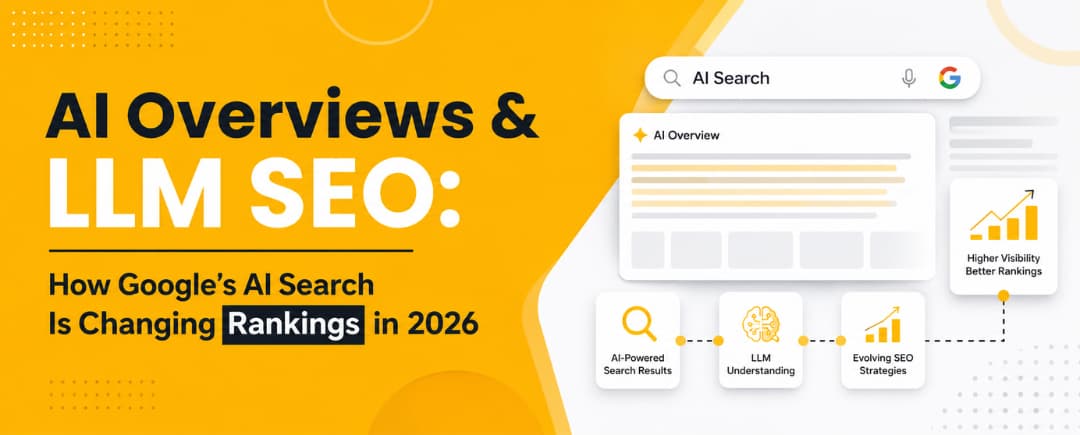


Google Search does not look the same in 2026. Here is what AI Overviews and LLM SEO mean for your rankings, your traffic, and how businesses need to measure success now.
A few years ago, people searched for something, looked through a list of blue links, and clicked a website. Today, Google can answer many questions directly at the top of the search page.
These answers are called AI Overviews.
At the same time, people are using ChatGPT, Gemini, Perplexity, Copilot, Claude, and other AI tools to find information, compare products, and choose businesses.
This change has created a new focus in digital marketing called LLM SEO. It is about making your website and brand easier for large language models and AI-powered search systems to understand, trust, mention, and cite.
The change is already huge. Google reported in May 2026 that AI Overviews had more than 2.5 billion monthly active users. Google AI Mode had also passed 1 billion monthly active users.
SEO is not disappearing. It is becoming wider.
Businesses now need to think about rankings, citations, mentions, brand visibility, and direct answers at the same time.
Google AI Search
What Are AI Overviews?
AI Overviews are AI-generated answers that Google may show above or around traditional search results.
Instead of giving users only a list of websites, Google can collect information from different sources and create one useful answer.
For example, someone may search:
"What is the best CRM for a small business?"
Google may show an AI-generated comparison before the usual search results.
The answer can include:
- A short explanation
- Product recommendations
- Important differences
- Supporting details
- Links to source websites
- Follow-up questions
This means a website does not only compete for position one anymore.
It can also compete to become a source inside the AI answer.
Google says AI Overviews are mainly shown when its systems believe an AI-generated response will add something useful beyond normal search results.
Query Fan-Out
How Do Google AI Overviews Work?
Google AI Overviews use Google's existing Search systems together with generative AI.
Google explains that its AI search features can use a method called query fan-out.
This means Google may take one question and search several related topics behind the scenes.
For example, someone asks:
"What is the best laptop for a graphic designer under $1,500?"
Google can then bring information together into one answer.
That changes SEO.
A page may now have opportunities to appear because it answers one useful part of a larger question, even if it does not rank number one for the original keyword.
Google confirms that AI Mode and AI Overviews may use query fan-out to search across related subtopics and sources before building an answer.
Whether you're looking to increase traffic, generate more leads, or improve your digital presence, our experts are here to help.
Search Behaviour
Why Are AI Overviews Changing SEO Rankings?
Traditional rankings still matter, but they no longer tell the complete story.
A page can rank well and still receive fewer clicks if Google provides enough information directly on the results page.
Research from Pew Research Center found that users clicked a normal Google result in only 8% of visits when an AI summary appeared, compared with 15% of visits when there was no AI summary.
— Pew Research CenterOnly about 1% of visits containing an AI summary resulted in a click on one of the links inside that summary.
This does not mean SEO has stopped working.
It means businesses should measure more than clicks.
In 2026, useful SEO metrics can include:
- Organic rankings
- Search impressions
- Website traffic
- AI citations
- Brand mentions
- AI share of voice
- Qualified leads
- Conversions
- Branded searches
- Visibility across multiple AI platforms
A company may receive fewer informational clicks but gain stronger brand exposure when an AI system repeatedly recommends or mentions it.
LLM SEO
What Is LLM SEO?
LLM SEO means improving your online content and brand presence so large language models can understand and surface your information when users ask relevant questions.
LLM stands for Large Language Model.
Examples include the technology behind:
- ChatGPT
- Gemini
- Claude
- Microsoft Copilot
- Perplexity
- AI-powered search experiences
LLM SEO is closely connected to terms such as:
- GEO: Generative Engine Optimization
- AEO: Answer Engine Optimization
- AI SEO: Search optimization for AI-powered discovery
These terms overlap, but the basic goal is simple:
Make your website and brand a useful, reliable source that search engines and AI systems can understand.
It is important to understand that Google does not say websites need a completely separate optimization system for AI Overviews.
Google states that normal SEO best practices continue to apply because its generative AI search features are connected to its main Search ranking and quality systems.
Comparison
Traditional SEO vs LLM SEO
Traditional SEO and LLM SEO should work together.
| Traditional SEO | LLM SEO |
|---|---|
| Targets search rankings | Targets AI mentions and citations |
| Focuses heavily on keywords | Focuses on questions, topics, entities, and context |
| Measures organic positions | Measures AI visibility and brand mentions |
| Builds backlinks | Builds wider authority and trusted mentions |
| Optimizes search snippets | Optimizes clear, extractable answers |
| Targets Google Search | Targets Google and other AI platforms |
| Tracks clicks and traffic | Also tracks citations and share of voice |
| Uses keyword research | Adds prompt and conversational research |
You do not need to choose one.
A strong strategy in 2026 should support both.
Foundations
Does Traditional SEO Still Matter for AI Overviews?
Yes.
Traditional SEO remains very important.
Google clearly says that normal SEO practices are still relevant for AI Overviews and AI Mode. A page generally needs to be indexed and eligible to appear in Google Search before it can be used as a supporting link in these AI experiences.
Businesses should continue working on:
- Technical SEO
- On-page SEO
- Internal linking
- High-quality content
- Website speed
- Mobile usability
- Structured data
- Search intent
- Backlinks
- Brand authority
- Local SEO
- Product information
There is also no special "AI Overview schema" that guarantees inclusion.
Google specifically says websites do not need a new AI text file, special AI markup, or special schema just to appear in its generative search features.
We help businesses build stronger online visibility, attract the right audience, and achieve long-term growth.
Optimization
How to Optimize Content for AI Overviews and LLM SEO
There is no magic formula, but some practices make content much easier for search and AI systems to understand.
Do not make readers search through five paragraphs to find a simple answer. If your heading asks "How much does local SEO cost?", answer it directly before going deeper. Clear answers are useful for users, search engines, voice search, featured snippets, and AI-generated results.
Keyword targeting is still useful, but modern SEO requires deeper topic coverage. For example, an article about "email marketing software" may naturally need to discuss:
- Features
- Pricing
- Automation
- Integrations
- Deliverability
- Small business use
- Ecommerce use
- CRM connections
- Advantages
- Limitations
- Alternatives
This gives search systems more context.
Make content easy to scan. Useful headings can include: What is it? How does it work? Why does it matter? How much does it cost? What are the benefits? What are the limitations? Which option is better? How do you choose? Question-based headings can also match the natural way people speak to AI tools.
Repeating what the first ten Google results already say may not create much value. Add something useful, such as original research, expert comments, real examples, case studies, customer questions, internal data, product comparisons, screenshots, step-by-step processes, or industry experience. Google's 2026 guidance for generative AI search places particular importance on useful and unique, non-commodity content rather than information that simply copies what is already available everywhere.
Trust matters even more when content gives advice about money, health, technology, business, or important decisions. Use reliable sources such as government websites, universities, research organizations, official company documentation, industry reports, and original studies. Pew's study of AI summaries found that 88% of the AI summaries it examined cited at least three sources. AI answers are often built from several sources rather than one page.
LLM visibility is not only about your website. AI systems may see your brand across many places, including industry websites, news publications, review platforms, YouTube, Reddit, business directories, social media, podcasts, comparison websites, and expert articles. Consistent information makes it easier for systems to understand what your company does.
Schema markup can help search engines understand information such as products, organizations, articles, reviews, events, local businesses, FAQs, and authors. However, structured data should match what users can actually see on the page. Google recommends keeping structured data accurate and consistent with visible content.
AI search is not limited to blogs. Your important commercial pages should clearly explain what the product is, who it is for, key features, benefits, pricing when possible, limitations, use cases, comparisons, reviews, FAQs, delivery or availability, and location information. Clear product information gives search systems more useful facts to work with.
Important details should not exist only inside an image, animation, or video. Google recommends making important information available in textual form so its systems can properly understand the content. Images and videos still help, but clear written information should support them.
Measurement
What Are the Best AI Overviews Trackers in 2026?
Traditional keyword tracking alone is no longer enough.
Businesses may also want to know:
- Does an AI Overview appear?
- Is my website cited?
- Is my competitor cited?
- Which page receives the citation?
- What does AI say about my brand?
- Which prompts mention my products?
- Is my AI visibility improving?
Some of the https://search.google.com/search-console/about and AI visibility tools available in 2026 include the following.
| Tool | Useful For |
|---|---|
| Google Search Console | Measuring Google search and generative search visibility |
| Ahrefs Brand Radar | AI Overview, AI Mode, ChatGPT, Gemini, Perplexity and brand visibility tracking |
| Semrush AI Visibility Toolkit | Prompt tracking, competitive AI visibility and brand analysis |
| OtterlyAI | AI search mentions, citations and prompt monitoring |
| Google Analytics 4 | Measuring traffic and conversions after users reach the website |
Google introduced dedicated Search Generative AI performance reports in Search Console in June 2026 for a subset of websites. These reports were designed to provide more direct information about impressions in experiences such as AI Overviews and AI Mode.
Ahrefs' Brand Radar can monitor brand visibility across AI platforms and track custom prompts in Google AI Overviews, AI Mode, ChatGPT, Perplexity, Gemini and Copilot.
Semrush's AI Visibility Toolkit includes AI visibility measurement, competitor research, prompt tracking, brand performance and citation opportunities.
OtterlyAI supports monitoring across Google AI Overviews, Google AI Mode, ChatGPT, Gemini, Perplexity, Copilot and Claude, with daily monitoring available for tracked searches.
The right LLM SEO tool depends on what you want to measure.
Metrics
What Should You Track With an LLM SEO Tool?
Do not track only whether your brand appears once.
Look at the bigger picture. Useful metrics include:
- AI Brand Mentions: How often does an AI platform mention your brand?
- Citations: Which pages from your website are being used as sources?
- AI Share of Voice: How often does your brand appear compared with competitors?
- Prompt Visibility: Which customer questions produce your brand as an answer?
- Competitor Citations: Which websites are helping competitors appear in AI answers?
- Sentiment: How does AI describe your brand? Is the description positive, negative, neutral, accurate, or outdated?
- Conversions: Are people who discover you through search eventually calling, buying, booking, or requesting information? Visibility matters, but business results matter more.
Content Quality
Should You Create Hundreds of AI-Written Pages?
No.
Publishing hundreds of weak pages simply because AI can create them quickly can hurt rather than help.
Google says generative AI can be useful for research and content organization. However, creating large amounts of pages without adding value may break Google's spam policies on scaled content abuse.
Quality should come before quantity.
A smaller number of useful pages with real experience, reliable sources, strong explanations, and original insight can be much more valuable than hundreds of nearly identical articles.
Keyword Research
How AI Search Changes Keyword Research
Keyword research is becoming keyword plus prompt research.
Traditional search:
"best CRM software"
Conversational search:
"What is the easiest CRM for a small sales team that does not have a dedicated IT person?"
Traditional search:
"SEO agency Toronto"
Conversational search:
"Which SEO agency in Toronto is good for a small ecommerce company?"
Pew Research found that longer searches were much more likely to generate AI summaries. Only 8% of one- or two-word searches in its study generated an AI summary, while 53% of searches containing ten words or more did so.
— Pew Research CenterThis makes long-tail questions and natural language more important for content planning.
Common Mistakes
Common LLM SEO Mistakes to Avoid
Businesses should avoid treating AI search as an easy shortcut. Common mistakes include:
- Stuffing keywords into every paragraph
- Publishing copied or generic content
- Creating hundreds of low-value AI pages
- Ignoring technical SEO
- Using fake statistics
- Writing without sources
- Ignoring brand mentions outside the website
- Tracking rankings but not AI citations
- Creating content only for bots
- Ignoring product and service information
- Using schema that does not match the page
- Expecting instant results
The main goal remains simple.
Create information that deserves to be found.
The Bigger Picture
Is SEO Going Away Because of AI?
No.
SEO is changing, not disappearing.
Google's own 2026 guidance says SEO remains relevant because its generative AI search experiences still use Google's core Search ranking and quality systems to find useful web information.
What is changing is the definition of success.
Sometimes the user may discover your brand before visiting your website.
That makes brand authority and AI visibility more important than before.
AI search is creating one of the biggest changes SEO has seen in years. AI Overviews, Google AI Overviews, LLM SEO, GEO, AEO and conversational search are changing how people find information and how brands earn visibility.
The goal in 2026 should not be to abandon traditional SEO. The better approach is to combine strong technical SEO, useful content, clear answers, credible sources, structured information, brand authority, product optimization and AI visibility tracking.
Businesses that want to prepare for this change can work with Kings Digital, which provides SEO, AI SEO, LLM SEO, AEO, GEO, content strategy, technical optimization, semantic topic development, structured data, competitor AI visibility analysis and AI mention tracking as part of its broader digital growth approach.
Frequently Asked Questions
Google AI Overviews are AI-generated responses that may appear in Google Search. They collect information from different web sources and provide a direct answer with links that allow users to explore the topic further.
No. Traditional search results still exist. However, an AI Overview can appear before or alongside them, which can change where users focus and which results receive clicks.
LLM SEO is the practice of improving content and online brand information so large language models and AI-powered search tools can understand, mention, recommend, or cite the brand when answering relevant questions.
You can improve your chances by following strong SEO practices, publishing useful and original content, answering questions clearly, maintaining strong technical SEO, and building trustworthy brand signals. Google says there is no special markup that guarantees inclusion.
There is no single tool that is best for every business. Platforms such as Ahrefs Brand Radar, Semrush AI Visibility Toolkit and OtterlyAI provide different forms of AI mention, citation, competitor and prompt tracking. Google Search Console is also important for measuring Google visibility.
Yes, but keywords alone are not enough. Content should also cover topics, entities, questions, comparisons, search intent and conversational prompts.
A business can improve its chances by creating original content, strengthening technical SEO, answering important questions clearly, improving product and service information, earning trusted online mentions, using accurate structured data, and tracking AI citations.