
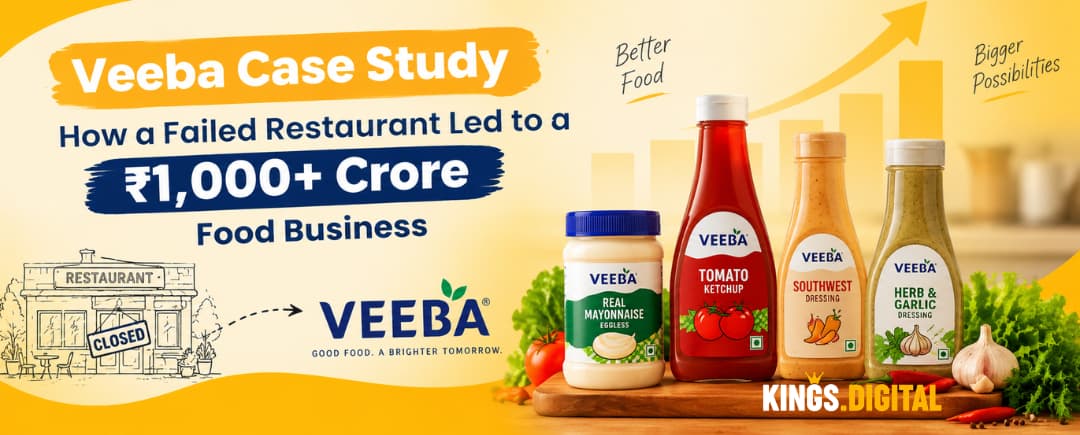



Failure usually tells entrepreneurs what went wrong.
Sometimes, however, it also tells them what business they should build next.
That is exactly what happened with Veeba.
Before building one of India's best-known homegrown sauce and condiment brands, founder Viraj Bahl had already experienced the food industry from several sides. He had worked in his family's food-processing business, watched that company get acquired, started his own restaurant chain, expanded it to six outlets, and eventually shut the entire business down.
The restaurant venture failed.
But while running those restaurants, Bahl gained something more useful than another business idea: a deep understanding of food operations, consistency, supply chains, customer preferences and the difficulty of scaling food businesses.
In 2013, he returned to food manufacturing and launched Veeba
Instead of immediately fighting for supermarket shelves, Veeba first went behind the scenes and supplied sauces to restaurants and large quick-service restaurant chains.
That B2B foundation eventually became the starting point for a large consumer brand.
Business Case Study
Today, Veeba's journey is an important case study in problem-solution fit, B2B-first market entry, product innovation, distribution, FMCG marketing and learning from failure.
Want a growth story like Veeba's?
Talk to Kings DigitalWhat Is Veeba?
Veeba is an Indian food brand best known for products such as:
- Mayonnaise
- Sauces
- Dips
- Sandwich spreads
- Salad dressings
- Ketchup
- Pasta sauces
- Hot sauces
- Cooking sauces
- Other convenience-food products
The flagship Veeba brand belongs to VRB Consumer Products Private Limited, formerly known as Veeba Food Services Pvt. Ltd.
Veeba was launched in 2013 by entrepreneur Viraj Bahl. The company's corporate office is currently in Gurugram, Haryana.
The company describes its focus around three broad ideas:
Great Taste + Quality Ingredients + Better-For-You Products
Its R&D operation also plays an important role in developing formulations, recipes and new products.
But to understand why Veeba worked, we first need to understand the market problem Bahl saw.
The Problem – A Gap in India's Condiment Market
India has always had a strong food culture.
But during the period when Veeba was being conceived, the packaged sauces and condiment category was still relatively underdeveloped compared with many international markets.
Bahl noticed this difference while travelling abroad. International supermarkets could dedicate large sections to sauces, dressings and condiments, while Indian consumers had a much narrower selection.
He later described the Indian condiment market as having plenty of opportunity because category penetration was still low. Veeba also identified an important gap: consumers wanted high-quality products without having to pay very high prices.
At the same time, India's restaurant and QSR sector was developing rapidly.
Restaurants needed sauces that could deliver:
- Consistent flavour
- Reliable quality
- Large-volume production
- Food-safety standards
- Competitive pricing
- Custom formulations
This created two related opportunities.
| Market | Problem |
|---|---|
| Restaurants and QSRs | Needed consistent, scalable and customised food solutions |
| Retail consumers | Needed better-quality sauces at accessible prices |
Instead of trying to solve both problems immediately, Veeba entered through the side where Bahl already had experience.
B2B food service.
Viraj Bahl's Journey Before Veeba
Veeba's story actually began long before the company existed.
Viraj Bahl grew up around the food-processing industry.
His parents, Rajiv and Vibha Bahl, had built Fun Foods, a company known for products including mayonnaise, sauces and other processed foods.
Viraj joined the business in 2002 after studying Industrial Engineering at Singapore Polytechnic and working with the merchant navy.
Over the following years, he gained hands-on experience in manufacturing and the food business.
Then came an important turning point.
In 2008, Fun Foods was sold to German packaged-food company Dr. Oetker for a reported ₹110 crore.
Viraj reportedly opposed the sale because he wanted to continue building the company.
But the decision ultimately pushed him toward entrepreneurship.
The First Business – Pocket Full
After leaving the family business, Bahl entered the restaurant industry.
In 2009, he launched a restaurant chain called Pocket Full.
Eventually, the company expanded to six restaurants.
On paper, the opportunity looked attractive.
Urban consumers were eating outside more frequently, global cuisines were becoming more familiar, and India's young population represented a potentially large restaurant audience.
But operating restaurants proved far harder than expected.
By 2013, all six outlets had shut down.
Why the Restaurant Business Failed
The failure became one of the most important learning experiences behind Veeba.
Restaurants Have High Operational Complexity
A restaurant is not simply about making good food. Every location requires control over employees, inventory, food preparation, service, rent, supply chains, hygiene, customer experience, wastage and daily operations. Problems in any one area can quickly affect profitability.
Scaling Is Expensive
Opening another restaurant means adding another physical operation. You need another property, kitchen, team, equipment, licences and working capital. That makes restaurant expansion very different from scaling packaged food through one manufacturing infrastructure and a larger distribution network.
Consistency Is Critical
Customers expect their favourite dish to taste the same every time. But restaurants often struggle to maintain identical results across locations, employees and shifts. Standardised sauces, bases and condiments can solve part of this problem. That observation later became highly relevant to Veeba's B2B model.
Failure Taught Financial Discipline
Bahl has repeatedly spoken about how the restaurant failure taught him frugality and better financial discipline. He later said that understanding the “right expense at the right time” became one of the major lessons he carried into Veeba.
The restaurant business had failed.
But Bahl now understood restaurants much better.
And that knowledge revealed another opportunity.
The Turning Point – Move From Restaurant Owner to Restaurant Supplier
Instead of opening another restaurant, Bahl went back to food manufacturing.
His thinking changed from:
"How can I build a better restaurant?"
to:
"What product do thousands of restaurants repeatedly need?"
Sauces and condiments provided an attractive answer.
They are used repeatedly.
They affect taste.
They can be standardised.
They can be manufactured centrally.
And once a restaurant approves a formulation, there is potential for recurring B2B demand.
This transformed the business model.
Instead of managing hundreds of individual consumer transactions inside restaurants, Veeba could become part of the restaurant's supply chain.
A Huge Personal Bet
Starting again was financially difficult.
Much of the money Bahl had previously received following the Fun Foods transaction had already been invested in his restaurant venture and other assets.
To fund his next business, Bahl and his wife decided to sell their house.
The company says Veeba was initially funded through the sale of his home, and interviews have described the amount raised at around ₹50 lakh.
He used the fresh start to establish manufacturing operations in Neemrana, Rajasthan.
This time, however, the business had a much clearer foundation:
Known industry + Known problem + Repeat demand + Scalable production.
Turning a hard lesson into a ₹1,000+ Cr growth story takes the right strategy.
Book a Strategy CallVeeba's Business Model – B2B First, B2C Second
One of the smartest elements of Veeba's strategy was the order in which the company entered the market.
Today, many consumer startups begin by creating a brand, spending on digital advertising and trying to generate retail demand.
Veeba effectively did the reverse.
Step 1 – Build Manufacturing Capability
Veeba established manufacturing and focused heavily on food quality and product development.
Step 2 – Win Institutional Customers
The company targeted restaurant chains and QSR businesses.
One of its early breakthroughs was Domino's.
The success of that relationship helped establish credibility and opened opportunities with other major food-service brands. Veeba later worked with names such as Burger King, Pizza Hut and KFC.
Step 3 – Learn at Scale
Serving large restaurant companies required Veeba to master:
- Standardisation
- Food safety
- Batch consistency
- Production
- Pricing
- Supply reliability
- Custom product development
Those capabilities would later become useful when the brand entered retail.
Step 4 – Enter B2C Retail
After proving its products in food service, Veeba expanded into the consumer market.
Instead of entering retail as a completely unknown manufacturer, it already had production capabilities and institutional experience.
Step 5 – Build Nationwide Distribution
This became perhaps Veeba's most important competitive advantage.
By 2023, Veeba had reached more than 150,000 sales points across 700+ cities, supported by 28 depots.
The strategy can therefore be simplified as:
How Veeba Won Its First Major Customer
Getting large QSR companies to trust an unknown manufacturer was not easy.
But securing Domino's proved to be a major validation point.
According to Bahl's entrepreneurial account, Veeba's first major Domino's order was around 20 metric tonnes of mayonnaise.
For the young business, that represented roughly a month's manufacturing capacity at the time.The significance went beyond revenue.
A large institutional client acts like validation.
If a supplier can meet the quality, volume and consistency standards of a national restaurant chain, it becomes easier to demonstrate credibility to the next client.
This created a powerful B2B growth loop:
Veeba's Product Strategy
Product innovation became one of Veeba's strongest pillars.
The company did not want to compete only through basic ketchup and mayonnaise.
It introduced varieties and flavours designed around evolving Indian tastes.
Its broader range has included products such as:
- Chipotle-style dressing
- Tandoori mayonnaise
- Garlic mayonnaise
- Peri-peri sauces
- Schezwan sauces
- Honey mustard
- Caesar dressing
- Sweet onion sauce
- Barbecue sauces
- Sandwich spreads
- Cheese dips
Veeba's food-service operation also develops customised products for restaurants and works with chefs and culinary teams to create specific flavour profiles.
This creates another competitive advantage.
Veeba is not only manufacturing existing demand.
Its product-development capability can also help create new demand.
The Distribution Strategy That Became Veeba's Moat
One of the biggest lessons from Veeba is that FMCG growth is not only about marketing.
Availability is marketing too.
A brilliant advertisement does not help much if consumers cannot find the product.
Veeba invested heavily in offline distribution.
By FY23, the company reported:
Veeba Distribution Footprint (FY23)
General trade and modern trade accounted for more than 90% of its retail business at the time.
This is particularly important in India.
Large e-commerce businesses can build strong digital brands, but FMCG consumption still frequently happens through supermarkets, neighbourhood stores and other physical retailers.
Veeba treated those shelves as strategically important real estate.
Digital Is Now Becoming More Important
Veeba's channel mix has continued evolving.
In a 2026 interview, Bahl said approximately 71–72% of revenue was coming from general trade, around 10% from modern trade, approximately 10% from e-commerce and roughly 10% from B2B.
He also explained that e-commerce had grown considerably from only around 2–3% two years earlier.This shows an important strategic shift.
Veeba built its moat offline first.
Now digital and quick-commerce channels are becoming increasingly important growth engines.
Veeba's Marketing Strategy
Veeba's marketing strategy changed with the maturity of the company.
Early Veeba could not rely on brand fame.
It first needed consumers to understand why they needed more varieties of sauces and how those products could be used.
Bahl has explained that the low penetration of the condiment category meant the company also had to educate consumers about products and usage.
This makes Veeba's marketing partly category creation.
It was not simply saying:
"Buy our sauce instead of another sauce."
It was also saying:
"Here are more ways sauces, dips and dressings can become part of your everyday food."
As the company grew, its media strategy became broader.
It used:
- Television
- Digital marketing
- Social media
- Influencer and celebrity-led communication
- Food content
- Retail visibility
- E-commerce
- Sponsorships
- Recipe-led communication
Veeba also became a title sponsor of MasterChef India, connecting the brand directly with cooking, food experimentation and home-food culture.
Veeba's Growth Numbers
The financial journey demonstrates how dramatically the company scaled.
Veeba reportedly took around four years to cross its first ₹100 crore revenue milestone.
Growth accelerated from there.
According to financial reporting:
Veeba Reported Revenue Growth
| Financial Year | Reported Revenue |
|---|---|
| FY22 | ₹542 Cr |
| FY23 | ₹811 Cr |
| FY24 | ₹885.2 Cr* |
| FY25 | ₹1,026.5 Cr* |
FY22 and FY23 figures were reported by Economic Times Retail. Inc42 Datalabs, using public filings and other datasets for VRB Consumer Products, reports revenue of approximately ₹885.2 crore in FY24 and ₹1,026.5 crore in FY25. *The later figures relate to VRB Consumer Products, the company behind Veeba and additional brands, so they should not be treated as Veeba-brand-only revenue.
The overall direction, however, is clear.
A business that began with a house being sold to finance a factory developed into a food company with revenue above ₹1,000 crore.
Want distribution and marketing that compound like Veeba's?
Get StartedThe 4Ps of Veeba
Product
Veeba focuses strongly on:
- Taste
- Product innovation
- Wide flavour variety
- Food safety
- Consistency
- Better-for-you options
- Customised B2B formulations
Its advantage is not simply one successful sauce.
It is the ability to repeatedly create products for changing consumer tastes.
Price
Veeba largely occupies an affordable-premium position.
The objective is to provide better quality and interesting flavours while remaining accessible enough for regular household consumption.
This helped the company address the gap Bahl identified between ordinary low-priced products and costly international alternatives.
Place
Distribution is one of Veeba's strongest parts of the marketing mix.
The brand sells through:
- General trade
- Modern retail
- E-commerce
- Quick commerce
- Its own website
- Food-service distribution
- Restaurants
- Hotels
- QSR chains
Rather than depending on one channel, Veeba created a multi-channel distribution ecosystem.
Promotion
Veeba combines product education with mass-market brand building.
Its promotion includes recipe inspiration, digital campaigns, television, food-related sponsorships, retail marketing and consumer engagement.
As the category matured, communication moved from simply teaching consumers about sauces toward building stronger brand recognition and recall.
Why Veeba's Strategy Worked
Veeba succeeded because several elements reinforced one another.
It Solved a Real Problem
The business began with demand that already existed. Restaurants genuinely needed reliable sauces.
It Entered B2B Before Fighting for Consumers
Institutional revenue provided product validation and manufacturing experience.
Product Came Before Promotion
Bahl continues to describe himself as a “product person” and has emphasised that even excellent entrepreneurship cannot rescue a product that fails to find market fit.
It Built Distribution Aggressively
Veeba understood that FMCG brands need both demand and availability.
It Continued Innovating
Instead of remaining a mayonnaise company, the brand constantly expanded flavours, formats and categories.
It Reinvested in Growth
Bahl previously described Veeba as being “loss-making by choice,” explaining that the company deliberately reinvested earnings into advertising, product launches and expansion rather than maximising short-term EBITDA.
This is a very different philosophy from cutting marketing investment simply to report higher short-term profit.
What Marketers Can Learn From Veeba
| Marketing Lesson | Veeba's Approach |
|---|---|
| Start with a real problem | Solved consistency and quality needs |
| Product-market fit comes first | Won demanding B2B customers |
| Distribution can become a moat | Built 150,000+ points of sale |
| Don't rely on one channel | Combined B2B, retail and digital |
| Education can create categories | Showed consumers how to use different sauces |
| Failure can provide customer insight | Restaurant experience revealed supply problems |
| Product innovation sustains growth | Expanded continuously into new flavours and formats |
| Brand building needs investment | Reinvested heavily into advertising and launches |
| B2B can validate B2C products | Institutional clients established quality credibility |
| Consumer behaviour keeps changing | Increased focus on e-commerce and quick commerce |
The Biggest Lesson From the Veeba Case Study
Perhaps the most interesting part of Veeba's story is that its biggest business opportunity came from a failed business.
Pocket Full did not become the restaurant chain Viraj Bahl originally imagined.
But running restaurants showed him problems that would have been difficult to understand from the outside.
He learned about operations.
He experienced supply-chain problems.
He understood consistency.
He saw how important sauces could be to food quality.
And instead of trying to fix a broken restaurant model, he moved deeper into the value chain and built a business that could serve thousands of restaurants and eventually millions of consumers.
That is an important entrepreneurial lesson.
Sometimes the best opportunity is not the product customers see. It is the problem happening behind that product.
Veeba found that hidden problem, built manufacturing around it, used B2B customers to establish credibility, entered retail after proving the product, created massive offline distribution and continued investing in innovation and marketing.
The result was not simply a sauce company.
It became a scalable consumer-food platform.
Veeba's Journey at a Glance
Fun Foods sold to Dr. Oetker
₹110 crore reported deal; pushed Bahl toward entrepreneurship
Pocket Full launched
Restaurant chain expanded to six outlets
Pocket Full shut down; Veeba launched
House sold to fund manufacturing in Neemrana, Rajasthan
First major Domino's order
Around 20 metric tonnes of mayonnaise — a key credibility milestone
Crossed first ₹100 crore milestone
Reportedly took around four years to reach
Rapid scaling
Revenue grew from ₹542 Cr to ₹1,026.5 Cr*
Nationwide distribution milestone
150,000+ sales points across 700+ cities and 28 depots
Read These Case Studies Also
- Case Study Minimalist Case Study – How Transparency Built a ₹500+ Crore Skincare Brand
- Case Study OYO Case Study: Business Model, Marketing Strategy & Growth Lessons
- Case Study Foam in Cleaning Products: How Bubbles Became a Powerful Marketing Signal
- Case Study Snowberry Case Study: How a Dessert Brand Turned Viral Food Trends into a Scalable Business
- Case Study Duolingo Case Study: How a Language Learning App Became One of the Most Famous Brands on Social Media
The Veeba case study shows that sustainable growth rarely comes from advertising alone. It starts with understanding a real market problem, creating a product customers genuinely need, building the right distribution system and then using marketing to multiply that advantage.
Veeba's journey also demonstrates why businesses should not separate product, sales, distribution and marketing. When all four work together, every new customer, retail shelf, product launch and communication campaign strengthens the next stage of growth.
For businesses looking to build that kind of connected growth engine, Kings Digital helps bring together SEO, content, paid advertising, digital strategy and performance marketing to turn strong business ideas into greater visibility, demand and measurable long-term growth.
Ready to build your own ₹1,000+ Cr growth engine?
Talk to Kings Digital