



Phitku is an Indian personal care and hygiene brand founded in 2025 by Neha Marda, Sumit Marda and Rahul Dokania. The company became known for turning traditional alum, commonly called phitkari in India, into a modern crystal roll-on deodorant.
The brand started with a simple idea: instead of using fragrance only to cover body odour, create a convenient product around an ingredient Indians have used for generations.
In a little over a year, Phitku reported serving more than 6 lakh customers, appeared on Shark Tank India Season 5, reached about ₹35 crore in FY26 gross sales, and attracted a majority investment from Ananta Capital in a transaction reportedly worth around ₹100 crore at a valuation of approximately ₹200 crore.
Business Case Study
That makes Phitku one of the more interesting recent Indian D2C personal care stories.
Phitku at a Glance
| Detail | Phitku Information |
|---|---|
| Brand | Phitku |
| Founded | January 16, 2025 |
| Founders | Neha Marda, Sumit Marda and Rahul Dokania |
| Industry | Personal care and hygiene |
| Hero product | Alum Infused Crystal Roll-On Stick |
| Key ingredient | Cosmetic-grade mineral alum |
| Original focus | Body odour and underarm care |
| FY26 gross sales | Around ₹35 crore, according to co-founder Sumit Marda |
| FY26 units sold | 5 lakh+ units, according to the founder |
| Customers | 6 lakh+ reported within around 14 months |
| Shark Tank ask | ₹1.8 crore for 1% equity |
| Implied Shark Tank valuation | ₹180 crore |
| On-air Shark Tank deal | ₹1.8 crore for 1% + royalty arrangement |
| Institutional investor | Ananta Capital |
| Reported 2026 valuation | Around ₹200 crore |
| Future target | ₹300 crore annual revenue run rate |
| Current expansion | Personal hygiene and oral care |
Phitku states that it was founded on January 16, 2025, while investment reports describe the business as having launched in early 2025.
Who Are the Founders of Phitku?
Phitku was founded by:
- Neha Marda
- Sumit Marda
- Rahul Dokania

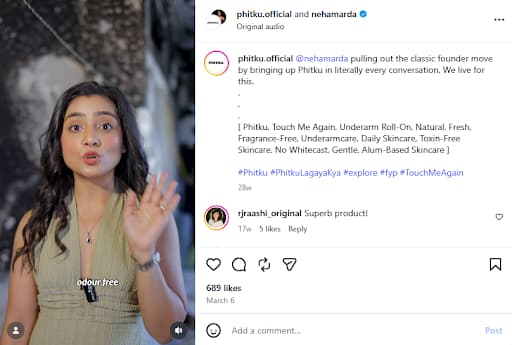
Neha Marda was already widely known through Indian television, including shows such as Balika Vadhu. Her visibility later became an important part of Phitku’s founder-led marketing.
Sumit Marda is the company’s co-founder and CEO and has become an important public voice around Phitku’s business growth and strategy.
Rahul Dokania is the third co-founder and has been part of the business from its early development.
Current company and investment reports consistently identify all three as Phitku’s founders.
How Did the Idea for Phitku Start?
The idea grew from a personal problem.
Neha Marda has said that after pregnancy she noticed changes in her body odour. As an actor, this made her particularly conscious of the issue.
She tried to find suitable products but felt that many available deodorants were mainly focused on fragrance rather than addressing the source of odour.
That search eventually led to alum, or phitkari.
Alum itself was not new. Indian households had used it for generations.
The opportunity was to take that familiar ingredient and turn it into something that was:
- Easier to use
- More consistent
- Better packaged
- Designed for modern personal care
- Suitable for everyday application
- Easier to understand for younger consumers
Neha has described the process as taking a familiar ingredient and creating a modern personal-care format around it.
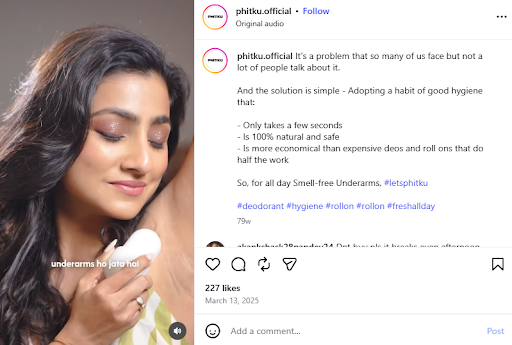
Reports also state that the team spent several years researching and developing the product before commercially launching the brand.
What Does Phitku Sell?
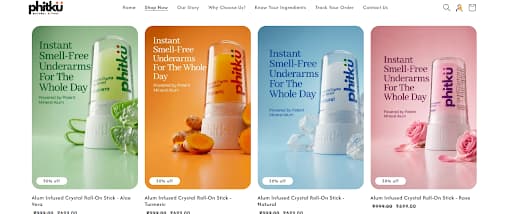
Phitku’s main product remains its Alum Infused Crystal Roll-On Stick.
As of September 2026, Phitku’s website lists five major crystal roll-on options:
- Natural
- Aloe Vera
- Turmeric
- Rose
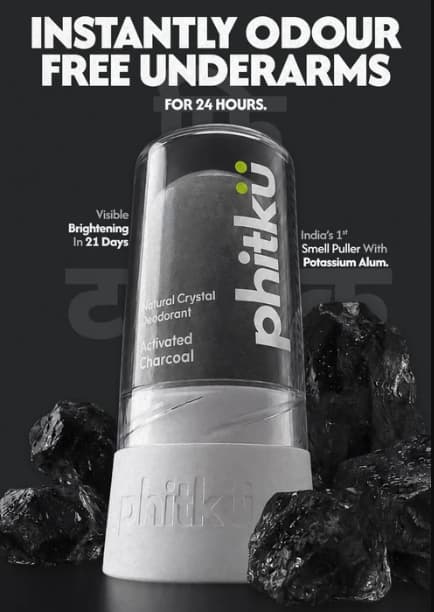
Recently, they have launched a different variant in “Charcoal” that specifically focuses on men’s underarms, as men’s skin is different from women’s.
The roll-ons are currently listed at ₹699, against an indicated MRP of ₹999. The company says one roll-on is designed to last around three to five months with normal daily use.
Phitku has also started moving outside underarm care.
In August 2026, the company entered oral care with Phitku Mouth Paste, built around the same broader positioning of addressing odour rather than simply masking it.
This expansion suggests Phitku wants to become more than an alum deodorant company.
Its larger opportunity appears to be functional personal hygiene.
What Is Phitku’s USP?
Phitku’s biggest strength is not that it invented alum.
It is how it positioned, packaged and explained alum.
1. A Familiar Indian Ingredient in a Modern Format
Phitkari is already familiar to many Indian consumers.
Phitku gives that traditional ingredient a modern product format, premium packaging and a clear use case.
The company’s own positioning describes this as “Ancient alum. Modern you.”
2. Odour Control Instead of Fragrance-Led Positioning
Many deodorant advertisements focus on how the product smells.
Phitku focuses its messaging on the bacteria associated with body odour.
The brand says alum helps limit odour-causing bacteria while allowing normal sweating rather than simply covering the smell with artificial fragrance.
3. Fragrance-Free and Alcohol-Free Positioning
Phitku promotes its crystal roll-ons as being free from artificial fragrance and alcohol.
The brand also says the products do not contain aluminium chlorohydrate, parabens or several other additives commonly questioned by ingredient-conscious shoppers.
4. Long Product Life
The company says one crystal roll-on can last approximately three to five months with regular use.
This helps Phitku defend a price that may initially appear high compared with ordinary raw alum.
Why Does Phitku Cost More Than Normal Phitkari?
This question became part of the brand’s story itself.
Consumers can buy basic blocks of alum cheaply in local markets. Phitku, however, sells its roll-on as a finished personal-care product rather than as raw alum.
Its value proposition includes:
- Cosmetic-grade alum
- Product formulation
- Purification and processing
- Testing
- Convenient application
- Packaging
- Consistency
- Branding
- Customer support
- Distribution
Neha Marda has publicly addressed criticism around selling an alum-based product at a premium price, arguing that the final product should not be compared directly with an untreated piece of traditional alum.
From a branding perspective, Phitku’s real business move was premiumising a commodity.
How Much Revenue Has Phitku Generated?
According to co-founder Sumit Marda, Phitku finished FY26 with approximately:
- ₹35 crore in gross sales
- 5 lakh+ units sold
He also stated that during the first week of December 2025, when the Shark Tank episode was filmed, Phitku had generated around ₹14 crore during that financial year.
Earlier, Sumit reported that Phitku crossed approximately ₹10 crore in sales within its first eight months and sold more than 2.5 lakh units by that stage.
These are founder-reported figures rather than audited public-company financial statements, but they show the speed at which the company says it grew.
How Many Phitku Products Are Sold Per Day?
Phitku has not publicly disclosed a stable current daily unit-sales figure.
However, there are two useful pieces of information.
Across FY26, Phitku reported selling more than 5 lakh units. Spread evenly across 365 days, that would equal an average of roughly:
1,370+ units per day.
Actual daily sales would have varied significantly because Phitku grew rapidly throughout the year.
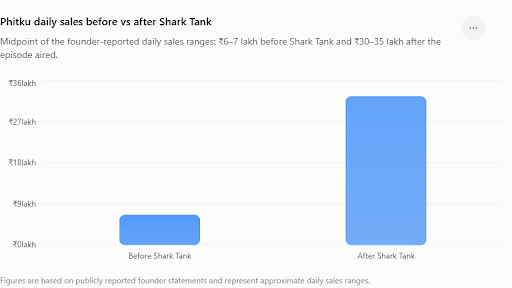
More strikingly, Sumit Marda reported that after its Shark Tank episode:
Daily sales increased from ₹6–7 lakh to ₹30–35 lakh per day.
He described Phitku as operating at roughly five times its earlier scale during the period immediately after the show.
That ₹30–35 lakh figure should be understood as a reported post-Shark Tank sales level, not necessarily Phitku’s permanent daily sales figure today.
What Happened to Phitku on Shark Tank India?
Phitku appeared on Shark Tank India Season 5.

The founders entered the Tank asking for:
₹1.8 crore for 1% equity.
That implied a valuation of:
₹180 crore.
The valuation immediately became an important part of the discussion.
There were also questions from the Sharks around the way some revenue numbers were presented during the pitch.
The televised negotiations eventually resulted in an offer from Aman Gupta and Anupam Mittal involving:
Watch on InstagramPhitku on Shark Tank India₹1.8 crore for 1% equity, along with a 5% royalty arrangement until ₹5.4 crore was recovered.
The Shark Tank appearance did more than provide investment visibility.
It introduced Phitku to a much larger national audience.
How Much Did Shark Tank Increase Phitku’s Sales?
According to Sumit Marda, the impact was immediate.
Before Shark Tank:
- Website traffic: 10,000+ visits per day
- Daily sales: ₹6–7 lakh
Around ten days after Shark Tank:
- Website traffic: 50,000+ visits per day
- Daily sales: ₹30–35 lakh
That means the founder reported approximately 5X operating scale following the episode.
He also said orders and traffic surged immediately after the episode aired and that the company’s warehouses across four states had to handle the sudden demand.
For Phitku, Shark Tank became as much a marketing event as a fundraising event.
How Many Customers Does Phitku Have?
By July 2026, Phitku said it had served:
More than 6 lakh customers within approximately 14 months.
The company sells through:
- Its own D2C website
- Online marketplaces
- Quick-commerce platforms
The customer figure was disclosed by the company around the time of its Ananta Capital transaction.
Who Invested in Phitku?
Phitku remained bootstrapped during its early growth.
Its major institutional turning point came in July 2026, when private-equity firm Ananta Capital acquired a majority stake.
The transaction involved:
- Fresh primary capital going into the company
- Secondary purchase of existing shares
- Partial liquidity for the founders
- Continued involvement of all three founders
Phitku described Ananta Capital as its first institutional investor.
What Is Phitku’s Valuation?
The exact financial terms were not officially disclosed by the company.
However, Moneycontrol reported that:
Ananta Capital’s transaction was worth around ₹100 crore
and valued Phitku at approximately:
₹200 crore.
The founders retained a significant stake and continued leading the business.
This came only around 14 months after the brand’s launch.
Why Did Ananta Capital Invest in Phitku?
Ananta Capital highlighted several reasons for its interest.
The investment firm pointed to growing consumer demand for:
- Cleaner personal-care products
- Ingredient transparency
- Functional formulations
- Modern solutions within traditional categories
Ananta also noted that odour protection remains a large category with room for innovation.
The investor specifically described Phitku as having modernised an established ingredient such as alum into a proposition suitable for today’s consumers.
Why Did Phitku Grow So Quickly?
Phitku’s growth cannot be explained by one factor.
Several things worked together.
A genuine problem created the product
Neha’s own experience gave the company an easy-to-understand founder story.
The ingredient was already familiar
Phitku did not need to teach Indian consumers what phitkari was from zero.
The product looked different
A crystal roll-on gave an old ingredient a new format.
It created a clear category position
Instead of becoming one more perfume-led deodorant, Phitku positioned itself around alum and odour management.
Founder-led marketing gave it visibility
Neha Marda’s existing public profile helped introduce the brand to a large audience.
Shark Tank amplified awareness
The unusual product, celebrity founder, high valuation and debate around the pitch made the episode highly discussable.
It expanded distribution
D2C gave Phitku direct customer access, while marketplaces and quick commerce helped the company increase reach.
The product naturally creates educational content
Phitku can create content around:
- What causes body odour?
- What is alum?
- Why do underarms smell?
- What is the difference between fragrance and odour control?
- How does a crystal roll-on work?
- Why did older generations use phitkari?
That gives the brand many ways to educate before selling.
What Is Phitku’s Growth Strategy Now?
Phitku’s next stage appears to focus on becoming a broader personal hygiene platform.
After Ananta Capital’s investment, the company said it would use capital to:
- Develop new products
- Strengthen brand building
- Expand D2C sales
- Grow on marketplaces
- Increase quick-commerce presence
- Selectively enter international markets
The company has said it is targeting 4–5X growth over the following two years, with a goal of reaching approximately:
₹300 crore annual revenue run rate.
Why Is Phitku Moving Into Oral Care?
Its August 2026 Mouth Paste launch gives a strong clue about Phitku’s long-term positioning.
The business is taking the same basic philosophy used for underarms:
address odour rather than simply masking it
and applying it to breath and oral hygiene.
Phitku’s Mouth Paste includes refined alum along with ingredients such as red banana, neem and clove. The brand positions it as whole-mouth care rather than a conventional teeth-only toothpaste product.
This makes Phitku’s possible brand territory much bigger than deodorant.
It can potentially build products around odour, hygiene and functional everyday personal care.
What Makes Phitku an Interesting Business Case?
Phitku did not invent an entirely new ingredient.
It changed how an existing ingredient was:
That is the main lesson from the business.
Consumers previously associated phitkari with an inexpensive traditional household item.
Phitku repositioned the same broad ingredient category around:
That shift created room for a completely different price point and consumer experience.
Criticism, Customer Concerns and Public Debate Around Phitku
Phitku’s rapid growth has also brought criticism. The most common concerns online are its premium price compared with ordinary alum, crystal breakage, mixed results, skin irritation reported by some users, its return policy, and questions raised during its Shark Tank India appearance.
It is important to separate individual customer experiences from verified facts. A negative review does not prove that every customer will have the same experience, just as positive reviews do not guarantee results for everyone.
What Are People Criticising About Phitku?
| Concern | What People Are Saying | Phitku’s Position or Available Context |
|---|---|---|
| High price compared with normal phitkari | Many consumers question paying around ₹699 for an alum-based product when ordinary alum can be purchased locally for much less. | Phitku says its price reflects cosmetic-grade alum, purification, formulation, testing, packaging and convenience rather than simply the cost of raw alum. |
| Crystal breaking or cracking | Several consumers have reported that the crystal cracked, chipped or broke after use. Similar complaints also appear in marketplace reviews. | Phitku acknowledges that its natural crystal product is delicate and requires careful handling. Its own website advises customers about the product’s fragile nature. |
| Mixed results for pigmentation | Some customers say they noticed improvement in darker underarms, while others report little or no visible change. | Phitku markets its alum products as helping brighten uneven underarm skin, but individual results can vary. |
| Skin irritation or rashes | Some online users have reported redness, irritation or rashes after using alum or Phitku products. | Phitku recommends a patch test, particularly for sensitive skin, and says users should stop using the product if redness or irritation occurs. |
| Does not stop sweating | Some customers expect a deodorant-style product to reduce sweating and are disappointed when they continue to perspire. | Phitku’s product information explains that potassium alum focuses mainly on odour-causing bacteria and does not stop normal perspiration. |
| Application takes extra effort | The crystal needs to be wet before application and properly dried afterwards, which some consumers consider inconvenient. | This application process is part of using a solid alum crystal. Shark Tank judge Namita Thapar also questioned whether this extra step could reduce mass-market adoption. |
| Replacement and return concerns | Some customers have complained about difficulty obtaining replacements when crystals broke after weeks or months of use. | Phitku’s current policy limits post-usage concerns to a defined period and generally does not accept returns after delivery because the products are personal-care items. |
| Premiumisation of a cheap traditional ingredient | A common social-media criticism is that Phitku has simply placed inexpensive phitkari into premium packaging. | Phitku argues that consumers are paying for purified cosmetic-grade material, manufacturing standards, product design, consistency and convenience rather than raw alum alone. |
| Shark Tank financial presentation | The founders were questioned about revenue numbers that included GST and about how some financial information was presented. | Amit Jain and Anupam Mittal openly challenged the founders during the episode. The founders later said parts of the discussion and its resolution were edited for television. |
| ₹180 crore Shark Tank valuation | Some Sharks and viewers believed the valuation was aggressive for such a young business. | The founders defended their growth expectations. Months later, Ananta Capital’s majority-stake transaction reportedly valued Phitku at around ₹200 crore. |
| Founder responses to criticism | Some social-media users have felt Neha Marda’s responses to criticism were overly personal or defensive. | Neha has said the brand is deeply personal to her and that she engages with criticism because she wants to understand concerns and improve the business. |
Why Is Phitku’s Price So Controversial?
Price is probably the biggest debate around Phitku.
The brand currently lists many of its crystal roll-ons at around ₹699, while ordinary alum can often be purchased in local markets for a small fraction of that price. This has led many consumers on Reddit and other social platforms to ask whether the convenience and branding justify the difference.
Neha Marda has directly responded to this criticism.
She says the major cost is not simply the raw alum. According to her, Phitku spends on taking raw alum through a purification process to achieve the purity required for its finished cosmetic product. She has argued that she would not lower the price by reducing those standards.
This creates an interesting consumer debate.
The question is not really:
“How much does phitkari cost?”
It is:
“How much extra are consumers willing to pay for purification, testing, packaging, convenience, branding and a finished personal-care experience?”
Product Breakage Is Another Repeated Complaint
One of the more consistent practical complaints involves the crystal itself.
Some users have reported that their Phitku crystal:
- Developed cracks
- Started chipping
- Became rough
- Broke into pieces
- Became difficult to continue using
This concern appears in Reddit discussions as well as verified-purchase marketplace reviews.
Interestingly, even some consumers who liked the product’s odour-control performance complained about its durability. One discussion, for example, described positive results for odour and pigmentation while still reporting significant cracking.
Phitku itself states that its natural crystal is delicate in nature and needs proper care. Its return policy also says that damage caused by mishandling is not covered and that post-usage issues are generally considered only within a limited period after delivery.
Some Consumers Have Reported Skin Irritation
There are also individual online reports of:
- Rashes
- Redness
- Dryness
- Irritation
after using Phitku or alum-based underarm products.
These reports should be treated as individual experiences rather than evidence that the product causes reactions in everyone.
Phitku itself acknowledges that reactions can occur. Its current guidance recommends performing a patch test before full use, particularly for sensitive skin. It advises customers experiencing redness or irritation to discontinue use and consult a qualified healthcare professional.
Do Phitku Products Really Lighten Dark Underarms?
This is another area where customer experiences appear mixed.
Phitku markets several products with claims around helping improve pigmentation and uneven skin tone. Its product pages say alum’s astringent and exfoliating properties may help produce brighter and smoother-looking underarms over time.
However, online discussions contain both sides.
Some consumers report noticeable improvement.
Others say the product helped with odour but did little for pigmentation.
For an independent brand analysis, the safest conclusion is:
Odour control and skin-brightening should be treated as separate consumer expectations, and results reported by users are not consistent.
Shark Tank Also Raised Questions About Financial Transparency
The controversy around Phitku was not limited to its product.
During its appearance on Shark Tank India Season 5, Amit Jain questioned how the founders presented their financial figures.
The founders had discussed approximately ₹14 crore in revenue. During the conversation, it emerged that some reported revenue figures included GST.
Amit Jain argued that revenue should normally be presented without GST and questioned the clarity of the financial presentation. Anupam Mittal also raised concerns.
The Sharks also questioned:
- The company’s ₹180 crore valuation
- Revenue projections
- Founder withdrawals from profits
- How financial information was being communicated
The discussion became one of the most debated parts of the Phitku pitch.
However, the founders eventually received an on-air offer from Aman Gupta and Anupam Mittal.
Neha and Sumit later argued that the television edit made the disagreement appear more dramatic and that parts showing the resolution of those issues were not included in the final episode.
Was the ₹180 Crore Valuation Too High?
This also became a major topic of discussion.
Phitku entered Shark Tank asking:
₹1.8 crore for 1% equity
which implied:
₹180 crore valuation.
Some Sharks felt this was aggressive considering the company’s age and revenue at the time.
What makes the debate interesting is what happened later.
In July 2026, Ananta Capital acquired a majority stake in Phitku in a transaction that was reported to value the business at approximately ₹200 crore.
Therefore, the ₹180 crore Shark Tank valuation was controversial at the time, but a later institutional transaction was reportedly completed around a similar valuation range.
What Has Neha Marda Said About the Criticism?
Neha Marda has publicly acknowledged that criticism around Phitku exists.
She has also said that her responses can sometimes appear personal because the company grew from her own experience with body odour.
In a September 2026 interview, she said she values customer criticism because it helps a young brand identify areas where it can improve.
That distinction is useful when analysing Phitku.
The company has both:
highly positive customers who say the product works extremely well
and
critical customers who question its price, durability, convenience or results.
For example, Phitku’s own website currently displays thousands of mostly positive customer ratings for its leading roll-ons, while independent marketplaces and discussion forums contain a much wider range of experiences.
Are the Negative Claims About Phitku Proven?
Not all of them.
There are social-media posts describing Phitku with words such as “scam,” “overpriced,” or “just expensive phitkari.” These should be understood as consumer opinions, not established facts.
There are also online allegations claiming that negative reviews have been removed from the company’s website. I did not find sufficiently reliable independent evidence to establish that allegation as fact, so it should not be presented in an article as a confirmed practice.
What can be responsibly documented is that Phitku has faced public debate around:
- Premium pricing
- Product durability
- Mixed individual results
- Reports of irritation
- Application inconvenience
- Replacement policies
- Product claims
- Shark Tank financial presentation
- Its original ₹180 crore valuation
These criticisms do not erase Phitku’s commercial success. At the same time, rapid revenue growth and investment do not mean every customer concern should be ignored.
That tension is actually part of what makes Phitku an interesting Indian D2C case study.
Phitku’s Growth Journey in Simple Numbers
Phitku launched
Founded by Neha Marda, Sumit Marda and Rahul Dokania
Early D2C growth
Around ₹10 crore in sales and 2.5 lakh+ units sold, according to co-founder Sumit Marda
Business continued scaling
Around ₹14 crore in FY26 sales reported at the time
Phitku entered the Tank
Asked for ₹1.8 crore for 1% equity, implying a ₹180 crore valuation
Aman Gupta and Anupam Mittal made an offer
₹1.8 crore for 1% equity + 5% royalty until ₹5.4 crore was recovered
Daily business performance
Around ₹6–7 lakh in daily sales and 10,000+ website visits per day, according to Sumit Marda
Major sales and traffic increase
Daily sales reportedly increased to ₹30–35 lakh, while website traffic reached 50,000+ visits per day
Strong first financial year
Around ₹35 crore gross sales and 5 lakh+ units sold, according to the founder
Customer base expanded
Phitku reported serving 6 lakh+ customers
First major institutional investment
Ananta Capital acquired a majority stake in Phitku
Reported investment value
Deal reportedly worth around ₹100 crore
Reported company valuation
Approximately ₹200 crore
Category expansion
Phitku entered oral care with Phitku Mouth Paste
Expansion target
Company aims for around ₹300 crore annual revenue run rate and 4–5X growth over two years
In simple terms: Phitku went from launching an alum-based personal care product in 2025 to reporting ₹35 crore in FY26 gross sales, attracting more than six lakh customers, appearing on Shark Tank India, and reaching a reported valuation of around ₹200 crore within roughly a year and a half.
Final Thoughts
Phitku’s story is not simply about selling expensive phitkari.
The stronger business story is about identifying an overlooked traditional ingredient, improving its format, creating a clear problem-focused position, building a strong founder story and presenting the product to a modern D2C audience.
In a short period, the brand went from a bootstrapped alum roll-on business to a company reporting ₹35 crore in FY26 gross sales, more than 6 lakh customers and a reported valuation of around ₹200 crore.
Its next challenge will be different from its first.
Phitku has already shown that consumers will buy its interpretation of alum-based underarm care. Now it has to prove that the idea can stretch into oral care and other personal-hygiene categories without losing the simple identity that made the brand memorable in the first place.
Frequently Asked Questions
1. Who is the founder of Phitku?
Phitku was founded by Neha Marda, Sumit Marda and Rahul Dokania. The personal-care company launched in early 2025 and initially focused on alum-based crystal deodorants.
2. When was Phitku started?
Phitku states that it was founded on January 16, 2025. The company began with an alum crystal roll-on before expanding into other areas of personal hygiene.
3. What is Phitku’s valuation?
A July 2026 Moneycontrol report placed Phitku’s valuation at approximately ₹200 crore during Ananta Capital’s majority-stake transaction. The company did not publicly disclose the transaction’s exact financial terms.
4. How much revenue does Phitku make?
Co-founder Sumit Marda said Phitku closed FY26 with approximately ₹35 crore in gross sales and sold more than 5 lakh units during the year.
5. How much does Phitku sell in a day?
Sumit Marda reported that daily sales increased from approximately ₹6–7 lakh before Shark Tank to ₹30–35 lakh shortly after the episode aired. This was a post-show figure, not a confirmed current daily average.
6. Did Phitku get a deal on Shark Tank India?
Yes. On Shark Tank India Season 5, Phitku asked for ₹1.8 crore for 1% equity and received an on-air deal involving ₹1.8 crore for 1% plus a royalty arrangement from Aman Gupta and Anupam Mittal.
7. Who invested in Phitku?
Private-equity firm Ananta Capital acquired a majority stake in Phitku in July 2026. It was described as Phitku’s first institutional investment after the company had grown as a bootstrapped business.
8. How many customers does Phitku have?
Phitku reported serving more than six lakh customers within approximately 14 months of launch through its D2C website, marketplaces and quick-commerce channels.
9. What products does Phitku sell?
Phitku currently sells alum-infused crystal roll-ons in Natural, Aloe Vera, Turmeric, Rose and Charcoal variants. It has also entered oral care with Phitku Mouth Paste.
10. Why did Phitku become popular?
Phitku combined a familiar Indian ingredient with modern packaging, clear odour-focused positioning, founder-led storytelling, D2C distribution and Shark Tank exposure. Its unusual product and rapid reported growth also attracted significant attention.